
U.S. Joins Israel in Strikes Targeting Iran’s Nuclear Infrastructure
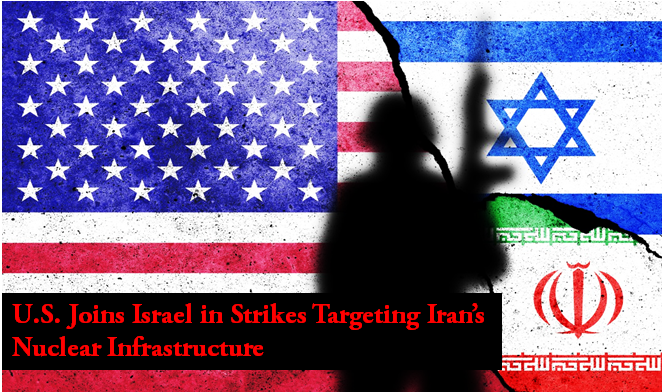
Washington/Tehran — In a significant escalation of the ongoing conflict, the United States joined Israel in targeting Iran’s nuclear program, launching coordinated airstrikes on three major nuclear facilities early Sunday morning. U.S. warplanes carried out precision bombings on sites in Natanz, Isfahan, and Fordow, areas believed to contain uranium enrichment and storage operations.
Despite the high-profile nature of the strikes, the Biden administration confirmed that Congress was not briefed in advance. U.S. Defense Secretary Pete Hegseth stated that the decision was made under emergency national security provisions. The administration later claimed that it complied with the War Powers Act by notifying lawmakers within the required 48-hour timeframe after the operation began.
According to General Dan Kaine, Chairman of the Joint Chiefs of Staff, the mission—Midnight Hammer—involved over 125 aircraft and included the deployment of fourteen 30,000-pound GBU-57 Massive Ordnance Penetrator bombs. B-2 Spirit stealth bombers and Tomahawk cruise missiles launched from U.S. submarines were also used in the operation.
Initial intelligence indicates that Iran may have removed critical uranium stores from the targeted facilities following Israel’s earlier strikes, potentially reducing the effectiveness of the U.S. assault. However, Pentagon sources reported “extensive structural damage” at all three sites.
Meanwhile, Iran’s Supreme Leader Ayatollah Ali Khamenei responded defiantly via social media, declaring that Iran’s efforts to confront and “eliminate the Zionist regime” had officially begun.
Iran Retaliates with Missile Strikes
In swift retaliation, Iran launched 40 missiles into Israel within hours of the U.S. attack. Among the arsenal were Khorramshahr-4 ballistic missiles, equipped with cluster warheads and designed to overwhelm Israel’s Iron Dome defence system. The missiles struck Tel Aviv, Haifa, and Ben Gurion International Airport, injuring at least 28 people and causing significant infrastructure damage. Social media footage showed collapsed buildings and emergency crews responding to scenes of destruction.
The Khorramshahr-4 missile, which has a range of 2,000 kilometres and the ability to split into multiple warheads mid-flight, represents one of Iran’s most advanced long-range weapons. Iranian military officials claim it is capable of penetrating Israeli air defences.
Global Reaction and Nuclear Concerns
The United Nations’ International Atomic Energy Agency (IAEA) confirmed that, despite the strikes, radiation levels near the affected nuclear sites remained within normal limits. IAEA Director General Rafael Grossi urged all parties to avoid targeting nuclear facilities, warning of the catastrophic potential of such actions.
This dramatic escalation has drawn international concern and renewed fears of a broader regional conflict. The U.S. strikes, carried out just two days after President Donald Trump had indicated a two-week window for Iran to engage in renewed nuclear talks, mark a sharp departure from the administration’s earlier non-intervention stance.
Irish Samachar English News
{OR} Kindly click to follow the Irish Samachar News channel on WhatsApp
Comments are closed.