
Ireland Plans Major Citizenship Reform: Eight-Year Residency, Language Test and Financial Requirements Proposed
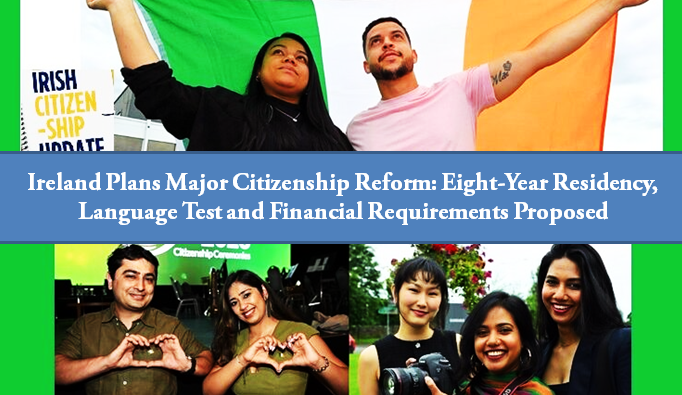
Dublin: The Irish Government is preparing a major overhaul of the citizenship and naturalisation system that could affect thousands of immigrants who have lived legally in Ireland, worked, paid taxes and are approaching eligibility to apply for Irish citizenship.
Among the most significant proposals under consideration are increasing the qualifying residence period from the current five years to eight years, introducing a language requirement in English or Irish, establishing a civics test on Irish society and democratic institutions, and requiring applicants to demonstrate financial self-sufficiency.
Justice Minister Jim O’Callaghan is expected to seek Cabinet approval on Wednesday, September 9, to begin work on the Irish Nationality and Citizenship Amendment Bill 2026 as a priority. The government plans to publish the general scheme of the legislation and refer it to the Oireachtas Justice Committee for pre-legislative scrutiny.
However, the proposals have not yet become law. The existing citizenship rules remain in force.
From five years to eight
The proposed extension of the residence requirement is likely to have the most immediate impact on prospective applicants.
Under the current system, a typical applicant must have five years of reckonable legal residence, including one continuous year immediately before submitting the application and a total of four years of reckonable residence during the preceding eight years.
Under the proposed system, applicants would generally need eight years of reckonable residence, including two continuous years immediately before applying and six years of reckonable residence during the preceding 10 years.
For immigrants who are currently approaching the five-year threshold, the change could mean waiting several additional years before becoming eligible.
One of the most important questions, however, is whether transitional arrangements will protect people who have already completed five years of reckonable residence or who submit their applications before any new rules take effect.
The government has not yet published detailed transitional provisions. Whether existing applicants or those who have already reached the current eligibility threshold will receive protection will become clearer when the draft legislation is released.
Language requirement: how difficult will the test be?
The proposed language requirement has generated considerable discussion among immigrant communities.
The government has indicated that citizenship applicants would have to demonstrate an ability to communicate in English or Irish. There has also been discussion about whether Irish Sign Language could be recognised in some circumstances.
However, the precise level of proficiency and the format of the assessment have not yet been determined.
It is therefore too early to assume that existing international examinations such as IELTS or OET will automatically become mandatory.
Several details remain to be decided, including the required score, whether reading, writing, listening and speaking would all be tested, and whether exemptions would apply to older people, people with disabilities or those with particular learning difficulties.
There is also a broader question about whether long-term residents who have worked and lived in English-speaking environments in Ireland for many years would still have to undergo a formal examination.
The government’s stated position is that new citizens should possess a basic ability to communicate in English or Irish and have sufficient knowledge to participate in Irish society.
Language alone will not be enough
The proposed reform is also expected to introduce a civics or citizenship test.
Applicants could be required to demonstrate knowledge of Irish society, the democratic system, politics, civic responsibilities and the country’s fundamental values.
It has not yet been decided whether the system would follow the model of Britain’s Life in the UK test, which uses a formal question-and-answer examination, or whether applicants would complete an educational programme followed by an assessment.
Government sources have indicated, however, that civic knowledge and language ability are expected to form central elements of the proposed citizenship system.
Sinn Féin has not rejected the principle of introducing language and citizenship requirements. Its justice spokesperson, Matt Carthy, has said that a reasonable language requirement in English or Irish and a citizenship test could be considered, while calling for detailed scrutiny of the government’s proposals.
Financial self-sufficiency could become a citizenship requirement
Another significant proposed change concerns an applicant’s financial circumstances.
The Justice Minister has indicated that citizenship applicants could be required to demonstrate that they are capable of supporting themselves and are not dependent on state assistance for an extended period.
The government has not yet determined the precise minimum income threshold.
The proposed calculation could take into account factors such as average earnings and the cost of living in Ireland.
The government had already approved the first phase of this policy in November 2025, when it indicated that restrictions could apply to applicants who had received certain forms of social welfare support for extended periods during the two years before applying for citizenship.
However, not all welfare payments are expected to be treated in the same way.
Child Benefit and maternity payments
Current indications are that certain long-term unemployment and housing-related supports could be taken into account when assessing financial self-sufficiency.
By contrast, payments such as Child Benefit and maternity-related payments are not expected to automatically disadvantage applicants.
The government is also considering whether ministerial discretion should be available in cases where an applicant has received state assistance only for a short period because of temporary circumstances.
The precise list of payments and the qualifying periods will be set out later if the legislation is enacted.
Could social housing affect citizenship applications?
This is one of the areas causing the greatest concern among immigrant families.
Information surrounding the proposed reform suggests that certain forms of state-supported housing could potentially be considered when assessing an applicant’s financial self-sufficiency.
However, the government has not yet published a definitive list of housing supports that would affect eligibility.
Questions remain over how the rules would treat social housing, housing assistance provided through voluntary organisations and accommodation provided through state agencies.
The final legislation and subsequent ministerial regulations are expected to clarify which forms of assistance would count, how long an applicant would need to have received them before they became relevant and whether exemptions would apply in special circumstances.
Tax debts and unpaid fines could also matter
The proposed system is also expected to place greater emphasis on an applicant’s financial and legal responsibilities.
Outstanding tax liabilities owed to the Revenue Commissioners or debts to the Department of Social Protection could potentially be taken into account.
Unpaid court fines may also affect an application.
The government’s objective is to assess whether applicants have met their financial obligations to the State and complied with their legal responsibilities.
‘Good character’ requirement could become more clearly defined
Irish citizenship law already requires applicants to be considered a person of good character.
The proposed legislation is expected to provide a clearer definition of what this means.
Serious criminal offences, repeated offending and certain immigration offences committed in Ireland or abroad could be specifically identified as grounds for refusing citizenship.
The government also intends to strengthen provisions allowing applications to be refused where an individual has deliberately breached immigration law.
Could Irish citizenship be revoked after it is granted?
The reform also proposes changes concerning the revocation of citizenship.
Ireland already has a mechanism for revoking Irish citizenship acquired through naturalisation in exceptional circumstances. The process was reactivated on April 7, 2025, following the resolution of procedural issues by the Supreme Court.
The proposed legislation would provide clearer powers to revoke citizenship in specified cases involving national security and public order and could establish a more streamlined process for dealing with such cases.
This is not intended to create general uncertainty for naturalised citizens. The government has indicated that revocation powers would be aimed at serious and exceptional circumstances, particularly those involving national security.
Longer residence requirement for spouses of Irish citizens
The proposed reforms could also affect foreign nationals who are married to Irish citizens.
Under the current system, the foreign spouse of an Irish citizen can qualify for citizenship after a shorter period of residence than a standard applicant, provided other conditions are met.
The government is considering extending this residence requirement.
However, the precise period has not yet been announced. It remains unclear whether the requirement would increase from three years to five years or potentially become longer.
Are these changes required by the EU?
Some reports have suggested that the proposed citizenship reforms are being introduced because of requirements imposed by the European Union.
However, citizenship and naturalisation remain primarily matters of national law in individual EU member states. The EU’s Migration and Asylum Pact does not itself require Ireland to introduce these specific citizenship conditions.
The government’s argument is instead that Ireland should move closer to the approach adopted by several other European countries, where language and civic knowledge requirements are already common.
The reform is also emerging against a wider political backdrop of tighter immigration policies following the implementation of the European migration framework.
The government may also view a more structured citizenship system as a way of addressing growing political pressure surrounding immigration and the rise of far-right movements.
Why is the Government making the changes now?
The number of people becoming Irish citizens has increased significantly in recent years.
According to European Commission figures, 24,059 foreign nationals acquired Irish citizenship in 2024, representing an increase of 32 per cent in one year. Indian nationals formed the largest group, with 3,946 people, accounting for approximately 16 per cent of the total.
The number of Indian nationals obtaining Irish citizenship increased further in 2025.
Justice Minister Jim O’Callaghan has said approximately 25,000 people became Irish citizens in 2025.
The government argues that, amid this rapid increase, citizenship should reflect a lasting connection with Ireland, economic self-sufficiency and integration into Irish society.
Strong opposition to the eight-year requirement
The proposed eight-year residence requirement has already attracted significant opposition.
Labour justice spokesperson Alan Kelly has called for the proposal to be abandoned, arguing that people who have worked, paid taxes, raised children and become part of Irish communities should not be forced to wait an additional three years.
Labour has also argued that, if a language examination becomes mandatory, the government should provide accessible and free language-learning opportunities to help applicants meet the requirement.
The Irish Refugee Council has criticised the proposals, warning that citizenship eligibility should not unfairly penalise people because of circumstances such as illness, unemployment or housing difficulties.
Doras chief executive John Lannon has also argued that extending the waiting period could undermine integration and described the proposals as unnecessarily harsh.
Is the reform likely to be rejected?
The possibility of the entire proposal being rejected by Cabinet appears limited given the Government’s current position.
Taoiseach Micheál Martin has publicly supported key elements of the proposed reforms, including the longer residence requirement, language assessment and financial self-sufficiency.
Nevertheless, the legislation remains at an early stage.
Important details — including the eight-year requirement, welfare rules, treatment of social housing, minimum income thresholds, language-test standards, exemptions for people with disabilities and the residence requirement for spouses of Irish citizens — could still change during pre-legislative scrutiny and subsequent parliamentary debates.
Sinn Féin has expressed support in principle for language and citizenship requirements but has not endorsed the Government’s specific proposal and has called for detailed examination.
As a result, there is currently no guarantee that the Bill will become law in its proposed form.
When could the new rules take effect?
Even if Cabinet approves the proposal on September 9, the new system would not take effect immediately.
The Government would first need to finalise the general scheme of the legislation. The Justice Committee would then conduct pre-legislative scrutiny before the full Bill is drafted and introduced to the Oireachtas.
The legislation would subsequently have to pass through the various stages in the Dáil and Seanad before being signed into law by the President.
Additional ministerial regulations or commencement orders may also be required for specific provisions, including language and civic assessments.
As a result, the proposed eight-year system cannot simply come into force immediately following Cabinet approval.
While some elements of the legal framework could potentially progress during 2026 if the Government moves quickly, the practical implementation of language tests, civic assessments, income thresholds and welfare eligibility rules is likely to take longer.
A full operational system could therefore extend into 2027.
What should people who have already completed five years do?
As of September 8, 2026, the current five-year reckonable residence requirement remains in force for a standard citizenship application.
The proposed eight-year requirement and language test are not currently law.
Therefore, anyone who has already completed five years of reckonable residence and satisfies the other existing requirements may currently be eligible to apply under the existing rules.
However, the crucial issue will be the transitional arrangements contained in the forthcoming legislation.
Applicants who are close to the five-year threshold should therefore pay particular attention not only to the Cabinet decision but also to the transitional provisions contained in the general scheme of the Bill.
Those provisions will help determine how the Government intends to treat people who have already qualified under the existing system but have not yet submitted their applications.
A fundamental change in the citizenship pathway
The proposed reforms signal a potentially significant change in Ireland’s approach to naturalisation.
Citizenship eligibility could move beyond simply counting years of residence and towards a broader assessment involving language ability, knowledge of Irish society, financial independence, reliance on state support, tax and legal obligations, and compliance with immigration rules.
Irish Samachar English News
Comments are closed.