
Brutal Attack on Indian Taxi Driver in Dublin Raises Renewed Concerns Over Safety
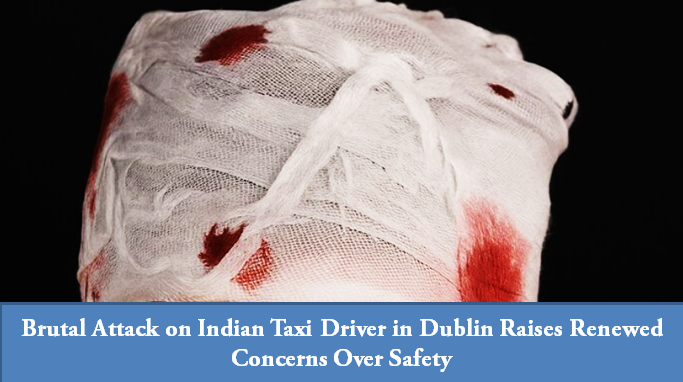
Dublin – In yet another alarming incident of anti-social violence targeting the Indian community in Ireland, an Indian-origin taxi driver was assaulted in North Dublin late Friday night. The victim, Lakhvir Singh (40)—a father of two and long-time resident of Ireland—was struck on the head with a bottle and left bleeding on the road in Poppintree, Ballymun, around 11:45 p.m..
Singh, who has lived in Ireland for over 23 years and has been a cab driver for the past decade, was attacked by two men, aged 20 and 21, who allegedly shouted racial slurs and demanded he “return to his country” before physically assaulting him. Singh attempted to seek help by knocking on nearby doors but received no assistance. He then contacted emergency services, and Gardaí arrived at the scene and transported him to Beaumont Hospital.
Though Singh’s physical injuries were not life-threatening, the psychological trauma has been significant. Speaking after the incident, Singh said he is deeply shaken and unsure if he can continue working as a taxi driver. His family, especially his children, are now fearful for his safety.
Pattern of Violence Against Indian Nationals in Ireland
This attack is the latest in a worrying pattern of targeted violence against members of the Indian community:
- On July 19, a man was seriously injured in broad daylight in Kilnamanagh.
- On July 27, a 32-year-old Indian data scientist was brutally beaten by a gang of six teenagers in Liffey Valley.
Despite repeated warnings issued by the Indian Embassy in Ireland, and growing concerns among human rights advocates, such incidents continue to occur, highlighting what many believe is an inadequate response from law enforcement and government authorities.
Unanswered Questions and Delayed Justice
Activists and members of the Indian community are increasingly frustrated by the lack of arrests in previous incidents—such as the brutal mob attack in Tallaght two weeks ago, in which no suspects have yet been detained. Many are asking:
- Why is progress in investigations so slow?
- Are authorities hesitating to act due to the identities of the perpetrators?
- Could there be deeper systemic issues or failures at play?
Some reports have also raised concerns over whether certain refugee groups or minors housed in accommodation centres could be involved in recent attacks, though no official link has been established.
A recent internal investigation found that multiple refugee children have gone missing from care centres in Dublin and other parts of Ireland. While the investigation did not draw a direct connection to recent violence, the lack of monitoring and accountability has raised further alarms.
Unequal Pathways to Residency Raise Policy Questions
There is also growing frustration over the disparity in immigration processes. While Indian nationals on General Employment Permits often wait up to 48 months for Stamp 4 (granting full work and residency rights), refugees can receive the same status within 4 to 12 months. Critics argue this discrepancy undermines fairness and may create social tensions.
Call for Action: Safety, Support, and Accountability
Leaders across the Indian diaspora are calling for immediate and sustained action:
- Stronger embassy engagement, including real-time reporting of attacks via official channels and social media.
- 24-hour support cells, including legal, health, and psychological services.
- Dedicated community helplines and networks to provide assistance and document incidents.
- Public pressure on Irish authorities to prioritise investigations and deliver justice swiftly.
The recent wave of violence has created a climate of fear, not only among Indian nationals but also among native Irish residents who value multiculturalism and justice. The slow pace of justice and lack of visible action risk eroding public trust in law enforcement and governance.
Until the attackers are identified, prosecuted, and preventive measures are strengthened, this fear will persist. The Indian community, which has contributed significantly to Ireland’s healthcare, technology, and education sectors, deserves to feel safe and supported.
This is not just a community issue—it is a national challenge that calls for decisive leadership, transparent communication, and united action to uphold the principles of safety, equality, and human dignity for all.
Irish Samachar English News
{OR} Kindly click to follow the Irish Samachar News channel on WhatsApp
Comments are closed.