
EU–US Trade Agreement Takes Effect, Ending Months of Tariff Uncertainty
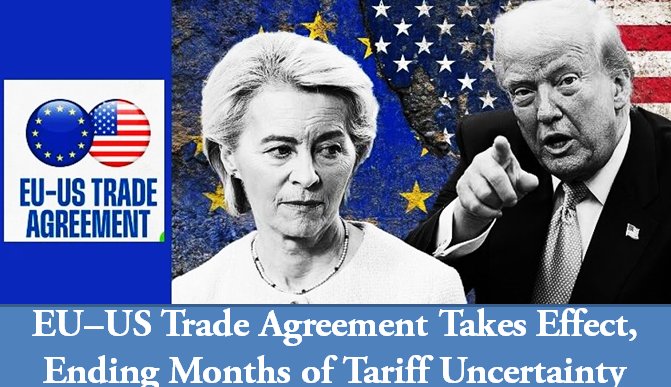
Brussels: The landmark trade agreement between the European Union and the United States has officially come into force, marking a significant step towards easing transatlantic trade tensions and providing greater certainty for businesses on both sides of the Atlantic.
The EU completed the necessary legal procedures to implement the agreement ahead of the July 4 deadline set by US President Donald Trump. The deal was approved by the European Parliament earlier this month and subsequently endorsed by EU member states, bringing months of trade uncertainty to a close.
The agreement was originally reached in July last year between President Trump and European Commission President Ursula von der Leyen.
Key Provisions of the Agreement
Under the new arrangement:
-
Most EU exports to the United States will face a maximum 15% tariff.
-
US industrial goods entering the European Union will benefit from duty-free access.
-
The agreement is intended to provide greater predictability for businesses while preventing a wider trade dispute.
Major Gains for US Exporters
The agreement is expected to significantly benefit American manufacturers and exporters, as a wide range of US industrial products will now enter the European market without import duties.
These include:
-
Machinery and industrial equipment
-
Chemicals and pharmaceuticals
-
Plastic products
-
Textiles
-
Metal products
-
Vehicles and aircraft
-
Furniture and toys
The agricultural sector in the United States is also expected to benefit through improved market access for products such as pork, bison meat, dairy products, cheese, nuts, soybean oil, seafood, salmon, Alaska pollock and lobster. Depending on the product, exports will either be duty-free or subject to reduced tariffs within agreed quota limits.
What Europe Gains
While the agreement does not eliminate US tariffs on European goods, EU officials argue that it prevents significantly higher trade barriers.
Instead of facing tariffs of 30% or more, most European exports—including automobiles, semiconductors and pharmaceutical products—will be subject to a 15% tariff ceiling.
Several strategic sectors will continue to enjoy zero or minimal tariffs, including:
-
Aircraft and aircraft components
-
Certain generic medicines and pharmaceutical ingredients
-
Chemical precursors
-
Natural resources not readily available in the United States
The reduction of US tariffs on European automobiles from 27.5% to 15% is viewed as a particularly important concession for Germany’s automotive industry.
Despite the agreement, some European politicians have argued that the deal disproportionately favours the United States.
Critics point out that while most US industrial exports will enter the EU duty-free, European exporters will still face tariffs of up to 15% when selling goods in the American market. Several lawmakers in France and the European Parliament have described the arrangement as overly favourable to Washington.
The agreement includes provisions allowing the European Commission to suspend certain concessions if the United States fails to honour its commitments or introduces additional tariffs affecting European exports.
The current agreement will remain in force until 31 December 2029, after which it will require a comprehensive review and fresh legal approval if both sides wish to renew it.
Trade Relations Remain Under Watch
Trade relations between the EU and the US remain sensitive, particularly following President Trump’s warning that countries imposing digital services taxes on American technology companies could face tariffs of up to 100%.
Against that backdrop, EU leaders view the new agreement as an important step towards maintaining stability between the world’s two largest advanced economies while avoiding a broader trade conflict.
However, the long-term impact of the agreement—particularly the effect of the 15% tariff ceiling on European exporters—will become clearer in the months ahead as businesses begin operating under the new trading framework.
Irish Samachar English
Comments are closed.