
U.S. Adds Ireland and Switzerland to Currency Monitoring List
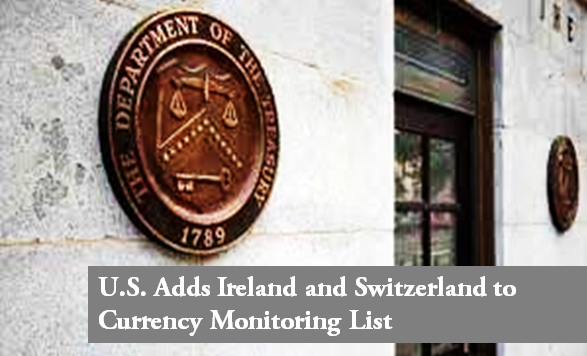
Washington: The U.S. Treasury Department has added Ireland and Switzerland to its semi-annual currency “monitoring list,” citing significant trade and current account surpluses with the United States. The decision, announced as part of the Treasury’s latest currency report, brings the two nations into closer scrutiny for their foreign exchange practices.
Ireland and Switzerland join existing members of the watch list, which includes China, Japan, South Korea, Taiwan, Singapore, Vietnam, and Germany. These countries are under heightened observation for potential currency practices that could provide unfair trade advantages.
The Treasury emphasised that no major U.S. trading partners were found to be engaging in deliberate currency manipulation. However, Ireland and Switzerland met the specific criteria for inclusion on the list:
- A bilateral goods trade surplus with the U.S. of at least $15 billion
- A current account surplus exceeding 3% of GDP
- Persistent one-sided foreign exchange market intervention
The report warned that continued monitoring of these economies would be necessary to assess compliance with fair exchange rate practices.
The Swiss National Bank (SNB) responded by rejecting any accusations of manipulation, stating that recent interventions in the foreign exchange market were necessary to protect the country’s economic interests. The SNB emphasised that it does not seek to distort the trade balance or gain an unfair competitive edge. Switzerland is currently experiencing negative inflation, further justifying, according to the SNB, the need for measured monetary policy responses.
While Ireland has yet to respond formally, the U.S. Treasury noted concerns regarding transparency around capital inflows into the country. Some social media discussions have also questioned the origins and impact of investment streams into the Irish economy.
The announcement comes just hours after former President Donald Trump held a rare meeting with Chinese President Xi Jinping. The talks—marking Trump’s first direct engagement with Beijing during this phase of renewed trade diplomacy—occurred as both sides navigate escalating disputes over tariffs and critical mineral supplies.
As part of easing tensions, Washington and Beijing agreed on May 12 to a 90-day suspension of select tariffs, a significant step toward resolving their long-standing economic confrontation. Despite the truce, the U.S. Treasury report maintained a firm stance on China’s lack of transparency in its exchange rate policies, a recurring concern throughout Trump’s presidency.
During Trump’s administration, no country was officially designated as a currency manipulator—except China, which received that label in August 2019 amid escalating trade hostilities. The designation was lifted in January 2020 as part of the Phase One trade agreement negotiations.
Irish Samachar English News
{OR} Kindly click to follow the Irish Samachar News channel on WhatsApp
Comments are closed.