
Poland Assumes European Union Presidency Amid Key Challenges
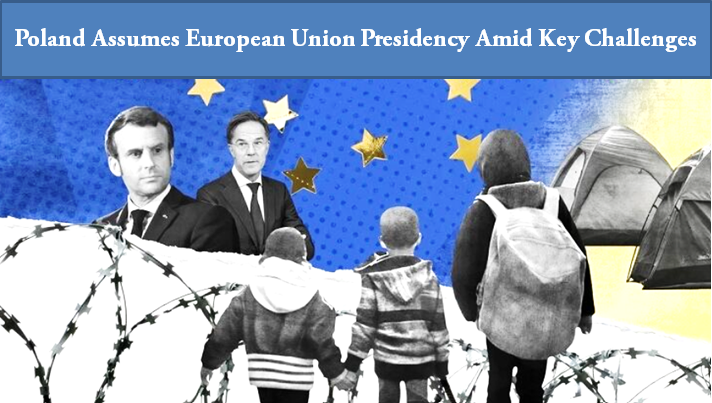
Brussels: Poland has officially assumed the rotating presidency of the European Union, with Polish Prime Minister Donald Tusk taking over from Hungary’s Viktor Orbán. The presidency, which rotates every six months, comes at a pivotal time for the EU as the bloc faces critical challenges in security, defence, and migration policy.
Tusk, a seasoned European political leader, has signalled a shift in approach from his predecessor, with a focus on unity and strengthening the EU’s collective security policies. Hungary’s tenure under Orbán drew criticism for prioritising national interests over EU consensus, particularly regarding foreign policy and Ukraine.
Hungary’s Controversial Tenure
During its presidency, Hungary adhered to traditional EU protocols in handling internal affairs but deviated significantly in foreign policy matters. Prime Minister Orbán pursued an independent diplomatic agenda, including visits to Russia, Ukraine, and China, under the pretext of promoting peace in Ukraine. These moves, seen as out of step with the EU’s collective stance, raised concerns among other member states. Hungary’s close ties with Moscow and criticism of Kyiv further strained relations within the bloc.
Poland’s Contrasting Vision
Observers expect Poland to adopt a markedly different approach during its presidency. As one of Ukraine’s staunchest allies, Poland has been a vocal advocate for strong EU sanctions against Russia and increased support for Ukraine. In contrast to Hungary, Poland aligns closely with NATO and EU objectives, particularly in the context of Russia’s aggression in Ukraine.
Prime Minister Tusk, a former president of the European Council (2014–2019) and leader of the European People’s Party, emphasised his commitment to bolstering European security. “My task is to convince all 27 EU member states that Europe can remain the safest and most stable place on earth,” Tusk stated. His agenda prioritises defence, economic stability, and energy security while fostering unity among EU member states.
Key Objectives and Challenges
Poland’s presidency will focus on:
Strengthening Support for Ukraine: Increasing military aid and sanctions against Russia.
Boosting Europe’s Defence Industry: Enhancing the EU’s defence capabilities to address current and future threats.
Ensuring Energy and Food Security: Addressing vulnerabilities exacerbated by geopolitical tensions.
However, achieving consensus may prove challenging, as countries like Hungary and Slovakia are expected to resist some of Poland’s initiatives. Additionally, Poland’s domestic political landscape, including the upcoming presidential election in May, could impact its ability to maintain neutrality on the EU stage.
Poland’s Growing Role in the EU and NATO
Since joining the EU in 2004, Poland has emerged as a key player in the bloc. Its economy has nearly tripled in size and now accounts for 4% of the EU’s total GDP. Poland is also a defence leader, allocating 4% of its GDP to military spending—the highest among NATO members. As the fifth most populous country in the EU, Poland holds significant strategic and economic influence.
Agnieszka Bartol, a representative of the EU, highlighted Poland’s focus on security during its presidency. “We aim to strengthen Poland’s position in the EU while addressing economic, energy, and food security concerns,” Bartol said, noting that the international context cannot be overlooked.
Irish Samachar English News
{OR} Kindly click to follow the Irish Samachar News channel on WhatsApp
Comments are closed.