
Saudi Arabia, Turkey and Pakistan Sign Trilateral Defence Pact Modelled on NATO-Style Mutual Defence
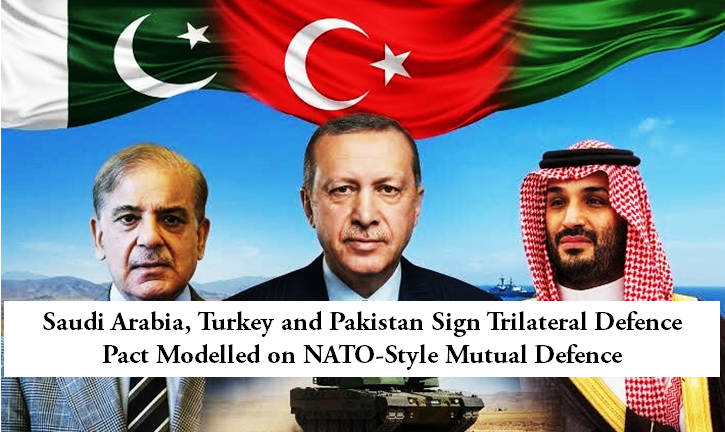
Riyadh: Saudi Arabia, Turkey and Pakistan have signed a trilateral defence agreement that includes a mutual security commitment under which an armed attack on one of the three countries will be treated as an attack on all three.
The Mecca Joint Defence Agreement, signed by Turkish President Recep Tayyip Erdoğan, Saudi Crown Prince Mohammed bin Salman and Pakistani Prime Minister Shehbaz Sharif, marks a significant expansion of defence cooperation among the three countries.
The principle has been compared with Article 5 of the NATO treaty, under which an attack against one NATO member is regarded as an attack against the alliance as a whole. Turkey is a member of NATO.
Agreement aims to strengthen mutual security
The agreement states that the three countries will strengthen cooperation in defence and work together in response to armed aggression against any member.
According to reports from Turkish media, the agreement could pave the way for expanded military exercises, joint training, intelligence sharing and cooperation in defence technology.
Saudi government sources said discussions on the agreement had been under way for some time, with recent developments in the region accelerating the process.
A similar bilateral defence agreement was signed between Saudi Arabia and Pakistan last year, but the new pact expands the framework to include Turkey.
Saudi Arabia seeks to diversify security partnerships
The agreement is also being viewed as part of Saudi Arabia’s efforts to diversify its strategic and security partnerships beyond its traditional relationship with the United States.
The development comes amid heightened regional tensions and attacks involving Iran and its allies, including strikes targeting Saudi infrastructure and military facilities.
The latest agreement has therefore been interpreted by some analysts as an attempt by Riyadh to strengthen its independent defence capabilities and develop additional security relationships.
Turkey says pact is not directed at any country
Turkey has stressed that the agreement is not aimed at any specific country.
Saudi officials have similarly said that the pact is not intended to establish a military axis or sectarian alliance.
Saudi Deputy Minister of Public Diplomacy Raed Krimli said the agreement was focused on developing sustainable defence capabilities rather than nuclear ambitions or an arms race. He added that it was not intended to threaten the security of any country in the region.
However, the agreement is likely to attract close attention from Israel, given Turkey’s longstanding criticism of Israeli policies towards the Palestinians and the increasingly complex security environment in the Middle East.
Potential implications for Iran
It remains unclear how the new defence arrangement will affect the ongoing regional conflict involving Iran and its allies.
Recent attacks by Yemen’s Houthi movement against shipping near Saudi ports, as well as violence involving Saudi-backed forces in Yemen, have further highlighted the security challenges facing Riyadh.
Saudi foreign policy expert Omar Karim of the University of Birmingham said the agreement could be viewed partly in the context of Iran’s expanding regional influence.
He noted that both Turkey and Pakistan share borders with Iran, potentially giving the two countries additional avenues through which to engage with Tehran.
Andreas Krieg of King’s College London said the agreement demonstrated a clear desire by Saudi Arabia to diversify its strategic partnerships beyond the United States.
Irish Samachar English News
Comments are closed.