
Relentless Weather Wreaks Havoc Across Ireland, Disrupting Lives and Recovery Efforts
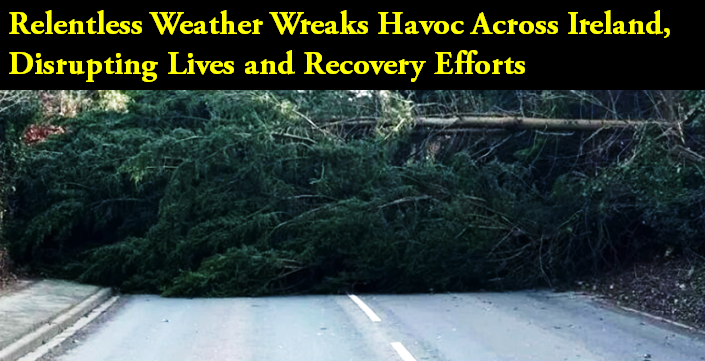
Dublin: The people of Ireland are facing significant disruption as relentless weather disasters continue to batter the nation. Just as the damage from Storm Eowyn was being assessed, strong winds and heavy rain have returned, compounding the challenges of recovery. Rain has persisted across much of the country, including Dublin, since yesterday morning, delaying comprehensive damage assessments.
The latest storm has toppled roofs and trees already weakened by Eowyn, with several counties, including Cork, Kerry, and Wexford, placed under yellow weather warnings. These warnings remain in effect until 9:00 a.m., with Wexford’s alert extending into the evening. The adverse weather has also hampered relief efforts.
Power Outages and Connectivity Challenges
Storm Eowyn left 490,000 homes, farms, and businesses without power. While electricity has been restored to a significant portion of these, 278,000 customers remain without supply. Broadband services have also been severely affected, with approximately 94,000 people initially offline. Efforts to restore connectivity are ongoing, though around 100,000 users are still impacted.
The ESB has revised its timeline for restoring power, now estimating that approximately 100,000 households will remain without electricity until early next month. Technicians from England and France have been called in to assist with repairs, and high-capacity generators are being procured from the European Union to accelerate recovery.
Basic amenities, such as water, hot meals, showers, and washing facilities, have been made available in the hardest-hit areas through local authorities. Temporary solutions for phone charging and broadband access have also been implemented.
Water Supply Crisis
Water supply disruptions have compounded the crisis, with nearly 100,000 people still without access to water. The lack of electricity at treatment plants remains the primary issue. Generators and alternative methods are being used to provide water to millions, but restoration efforts continue in heavily impacted areas, particularly along the west coast and in the Midlands, including Galway, Mayo, Clare, Cavan, Monaghan, Westmeath, Donegal, and Longford.
Water authority teams are working to resolve failures at sewage plants and restore water services. Updates on these efforts are being shared via official websites and social media channels.
Government Financial Assistance
In response to the extensive damage, Social Protection Minister Dara Calleary has announced a comprehensive financial assistance plan for those affected by the storm. The assistance will be rolled out in three phases:
Emergency Assistance – Immediate aid for essential items such as food and clothing will be provided, regardless of income.
Household Goods Replacement – Support for replacing kitchen appliances and furniture will be available, subject to a means test.
Home Repairs – Assistance for repairing storm-damaged homes will also be provided, based on income eligibility.
Income thresholds for the second and third phases are set at €50,000 for individuals, €90,000 for couples, and an additional €15,000 per dependent child. Minister Calleary emphasised the scale of the damage and the government’s commitment to supporting affected families and communities.
Irish Samachar English News
{OR} Kindly click to follow the Irish Samachar News channel on WhatsApp
Comments are closed.