
President Trump Announces U.S. Plan to Assume Control of Gaza Amid Controversy
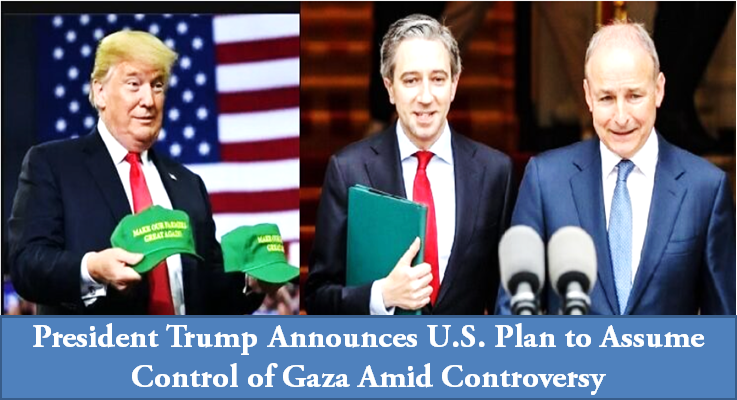
Washington, D.C. – In a controversial announcement, U.S. President Donald Trump has declared that the United States is prepared to take control of Gaza, following discussions with Israeli Prime Minister Benjamin Netanyahu. The declaration has sparked intense debate among political analysts, many of whom believe this move may be part of a broader strategy to facilitate the displacement of Palestinians from Gaza.
U.S. Plan for Gaza: Resettlement and Reconstruction
President Trump outlined an ambitious plan to transform Gaza into a “haven of peace,” stating that the U.S. is committed to neutralising unexploded ordnance, rebuilding infrastructure, and restoring homes and jobs in the region. Trump emphasised that, if necessary, the U.S. military could be deployed to secure the area during the transitional phase.
As part of his proposal, Trump introduced a special revitalisation plan for Gaza, suggesting that the relocation of the population might be necessary. He controversially remarked that up to 20 million people—an inflated figure compared to Gaza’s actual population of around 2 million—could potentially be resettled in neighbouring countries such as Jordan and Egypt, with American logistical support.
International Concerns Over Forced Relocation
Adding to the controversy, Israeli Defence Minister Israel Katz stated that not only Jordan and Egypt but also countries like Ireland, Spain, and Norway could be considered “legally obligated” to accept Palestinian refugees. Katz revealed that the Israeli military has been instructed to develop evacuation plans for large numbers of Palestinians from Gaza, including options for land, sea, and air routes.
Katz described the initiative as a “bold plan” to facilitate mass relocation, coordinated with American assistance, ahead of Gaza’s proposed reconstruction. His remarks have triggered widespread concern, particularly in countries like Ireland, which has historically maintained a strong pro-Palestinian stance.
Ireland’s Potential Role Amid Rising Concerns
Ireland, known as one of the most pro-Palestinian countries in Europe, has consistently supported Palestinian rights. The current government, led by Taoiseach Micheál Martin, along with ruling parties Fine Gael and Fianna Fáil, has even backed legislation aimed at limiting trade with Israeli-occupied territories.
Given Ireland’s political support for Palestine, there is speculation that the country could become a key destination for displaced Palestinians if mass expulsions were to occur. While public sentiment in Ireland may be divided on the prospect of accommodating a large influx of refugees, the pro-Palestinian policies endorsed by both major political parties could influence government decisions in favour of accepting refugees.
Global Reactions and Humanitarian Concerns
The international community has reacted with shock and concern to the possibility of mass forced relocations. Critics argue that such measures would constitute a clear violation of international law, particularly regarding the rights of refugees and the prohibition against forced population transfers.
Furthermore, comparisons have been drawn between the U.S.’s stance on Gaza and its ongoing efforts to deport undocumented immigrants from countries like India via special repatriation flights, often conducted without the explicit consent of the countries involved.
Analysts warn that if President Trump and Prime Minister Netanyahu proceed with plans to disperse Palestinians globally, countries like Ireland—with its robust refugee support systems—could face significant pressure to accept large numbers of displaced individuals.
Irish Samachar English News
{OR} Kindly click to follow the Irish Samachar News channel on WhatsApp
Comments are closed.