
Government Defeats Sinn Féin Bill to Ban Central Bank from Facilitating Israeli War Bonds
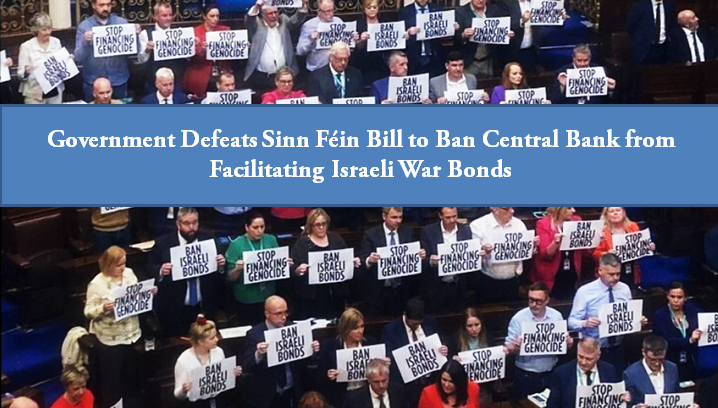
Dublin – The Irish government has successfully defeated a Sinn Féin bill aimed at prohibiting the Central Bank of Ireland from facilitating the sale of Israeli government bonds, commonly referred to as “war bonds”. The vote, held in the Dáil on Tuesday, saw the bill rejected by 87 votes to 75, despite recommendations from parliamentary legal advisers affirming its constitutionality.
The proposed legislation, titled the Restrictive Financial Measures (Israel) Bill 2025, sought to prevent the Irish Central Bank from approving bond prospectuses from the Israeli government, a move that would have effectively blocked their trade across the European Union.
Heated Debate and Parliamentary Tensions
The bill’s defeat sparked intense debate and protests within the Dáil. As the result was announced, opposition TDs shouted “Shame!” while others unfurled banners reading “Stop Funding Genocide” and “Ban Israeli Bonds” in a show of solidarity with Palestine.
Adding to the tension, a number of independent TDs who usually support the government—Barry Heneghan and Gillian Toole of the Regional Independent Group—broke ranks to vote in favour of the bill, leading to an embarrassing moment for the coalition.
Pro-Palestinian protestors in the Dáil’s public gallery disrupted proceedings, prompting a temporary suspension of the session. Outside, demonstrators gathered near the Central Bank, demanding legislative action to halt Ireland’s role in facilitating Israeli bond sales.
Government Response and Ministerial Position
Finance Minister Paschal Donohoe argued that the proposed legislation was “impractical”, claiming it would have no real impact on Israel’s capacity to raise funds internationally. He stated that Ireland’s participation in bond approvals is largely administrative and that blocking such sales would not materially influence Israel’s war financing.
In response, Sinn Féin leader Mary Lou McDonald accused the government of moral failure. “These bonds help fund weapons that have killed tens of thousands of men, women, and children,” she said. McDonald condemned the government’s stance as dismissive of the Irish public’s growing opposition to the war in Gaza and accused ministers of “smearing” ordinary citizens who support Palestinian rights.
Taoiseach’s Defence and Acknowledgement of Atrocities
Taoiseach Micheál Martin defended the government’s decision, saying that while Ireland continues to strongly condemn Israel’s actions in Gaza, the bill was a political manoeuvre designed to “drive a wedge between the government and the public”. Martin reaffirmed that he considers Israel’s conduct in Gaza as genocidal but emphasised that the government’s foreign policy must remain grounded in international legal frameworks and practicality.
Background: War Bonds and Ireland’s Role
Following the October 7, 2023, outbreak of war between Israel and Hamas, the Israeli government began issuing special bonds to fund its military campaign. These bonds require regulatory approval from an EU member state to be sold in the bloc. Prior to Brexit, this role was performed by the UK. Post-Brexit, Israel designated Ireland as its regulatory base, resulting in the Central Bank of Ireland approving the bond prospectus, effectively facilitating their trade across the EU.
Critics argue that this arrangement makes Ireland complicit in Israel’s military operations in Gaza, by allowing the country to raise capital via EU financial markets. Calls to sever this role have intensified in recent months amid mounting international concern over civilian casualties.
Following the bill’s defeat, pro-Palestinian activists launched a widespread campaign on social media to criticise the government and praise Sinn Féin’s efforts.
Irish Samachar English News
{OR} Kindly click to follow the Irish Samachar News channel on WhatsApp
Comments are closed.