
Government Faces Backlash Over Continued Sale of Israeli War Bonds Through Central Bank
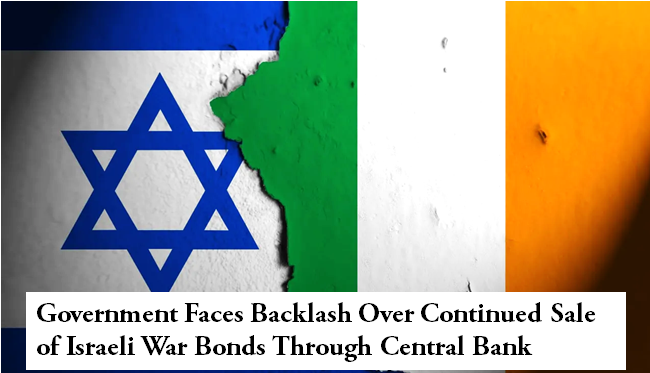
Dublin: The Irish government has come under intense scrutiny following its decision to permit the continued sale of Israeli war bonds through the Central Bank of Ireland, rejecting a parliamentary motion that sought to ban the practice.
The motion, introduced by the Social Democrats, was defeated in the Dáil after the government secured enough votes to override the proposal. A total of 71 TDs voted in support of the ban, but the motion was blocked by a government majority. This marks the second time such an initiative has been struck down, with a similar motion by Sinn Féin also failing previously.
Opposition Outrage
The decision drew sharp criticism from opposition parties, who accused the government of tacitly supporting the Israeli military campaign in Gaza by allowing the sale of bonds that could be used to finance military operations.
Social Democrats introduced the cross-party motion condemning the sale, while the government responded with a counter-motion emphasising its existing diplomatic efforts. Sinn Féin finance spokesperson Pearse Doherty labelled the government’s stance as “shameful, ”a sentiment echoed by People Before Profit (PBP) and other opposition TDs.
Two independent TDs—Barry Heneghan and Gillian Toole, both affiliated with the government coalition—broke ranks and voted in favour of the ban. Heneghan, who had supported a previous Sinn Féin motion on the issue, stated that Ireland should not facilitate the sale of bonds linked to destruction in Gaza.
Prime Minister Micheál Martin dismissed claims that the government is complicit in Israeli actions, rejecting accusations that it is enabling “genocide” in Gaza. He did, however, acknowledge that the EU-Israel trade agreement is under review and suggested it may need reassessment.
Legal and Institutional Complexity
Finance Minister Paschal Donohoe defended the government’s position at a Fine Gael parliamentary party meeting, stating that the Central Bank operates independently, and it is not legally permissible to impose political restrictions on its financial operations. He emphasised that EU law constrains such actions and that the Central Bank does not supervise or directly facilitate the sale of Israeli war bonds.
Donohoe added that he plans to engage with the Bank of Israel by the end of the summer regarding the matter but insisted that legislating to block the bond sales would violate EU financial regulations.
Tense Exchanges in Finance Committee
The controversy continued in the Oireachtas Finance Committee, where Central Bank Governor Gabriel Makhlouf and Director of Capital Markets and Funds Gerry Cross were grilled by TDs. The central bank officials clarified that the bond scheme, due for renewal in September, falls within the legal framework of EU financial law and that the Bank’s role is limited to regulatory compliance—not policy-making.
Governor Makhlouf acknowledged the humanitarian crisis in Gaza, saying he was “shocked by the situation”, but maintained that the Central Bank must act strictly within the legal and regulatory frameworks established by European law.
Social Democrats Deputy Leader Cian O’Callaghan questioned whether the UN Genocide Convention applies to the Bank’s actions. Makhlouf responded that the Bank is a creature of statute and must operate within its legal remit, irrespective of personal or political views.
However, Independent TD Catherine Connolly criticised the Bank’s stance as overly narrow and insufficient in the face of global humanitarian concerns. She rejected arguments that responsibility lies elsewhere, stating that “we are all complicit if we choose inaction in the face of atrocity.”
Irish Samachar English News
{OR} Kindly click to follow the Irish Samachar News channel on WhatsApp
Comments are closed.