
Government Confirms AI Will Disrupt Irish Employment Sector
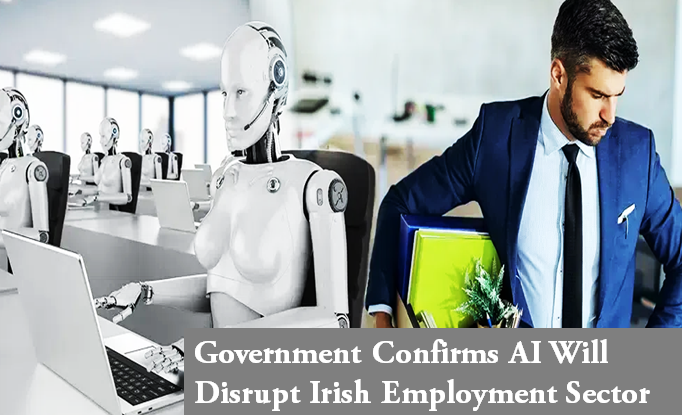
Dublin: The Irish government has officially acknowledged that the rapid development of artificial intelligence (AI) will significantly disrupt the country’s labour market. Minister of State for Artificial Intelligence, Niamh Smyth, made the statement during a parliamentary committee meeting focused on AI’s long-term impact, admitting that AI could lead to widespread job losses—particularly in sectors reliant on routine and repetitive tasks.
Financial Services and Graduate Recruitment Hit Hardest
A growing body of evidence supports the government’s concern. According to Morgan McKinley Ireland’s latest Employment Monitor, major financial institutions have already scaled back recruitment of accountancy and finance graduates due to automation and AI integration. Entry-level roles traditionally filled by graduates—such as payroll, accounts payable and receivable, and credit control—are increasingly being performed by AI systems.
A recent joint survey conducted by the Financial Services Union (FSU) and the think tank TASC confirmed that the financial services sector is among the most vulnerable, raising alarm among policymakers and trade unions alike. Members of the parliamentary committee have called for the development of strategies to support and redeploy workers displaced by emerging technologies.
Talent Pipeline at Risk
The Employment Monitor highlights a growing shortage of mid-level professionals, warning that today’s graduates are the future talent pool for middle-management and executive roles. Cutting graduate recruitment today could compromise business continuity and leadership development in the years ahead.
To mitigate this, the report stresses the need to retrain graduates in managing and supervising AI-driven processes. Equipping new hires with the technical skills to work alongside AI tools could prevent long-term damage to the labour market. Increased demand is already expected for data engineers, AI model supervisors, and tech-literate business analysts.
AIB AI Rollout Raises Concerns
Earlier this week, Allied Irish Banks (AIB) began deploying Microsoft-powered AI tools to staff. The initiative includes AI applications for budget reconciliation, document review, and basic audit checks—tasks previously performed by trained graduates. The rollout is part of AIB’s adoption of Microsoft 365 Copilot, integrating AI directly into tools such as Outlook, Word, Excel, Teams, and PowerPoint.
However, the FSU has voiced concerns that AIB’s AI deployment occurred without a formal agreement with employee unions. The union cited risks of displacement, job redundancy, and a lack of strategic retraining measures. They have urged the bank and other employers to prioritise reskilling and redeployment over downsizing.
In response, AIB has assured that it will provide comprehensive training and support to employees to ensure a smooth transition. The bank also confirmed ongoing engagement with trade unions regarding AI implementation.
Microsoft Layoffs and Irish Workforce Implications
Meanwhile, Microsoft—one of AIB’s key AI partners—has been aggressively restructuring its global workforce to focus on AI innovation. The company has cut more than 16,000 jobs globally in 2024 alone, including major layoffs in January, May, and June.
Microsoft CEO Satya Nadella recently disclosed that AI now writes over 30% of the company’s code, signalling a seismic shift in software development practices. Microsoft employs more than 4,000 people in Ireland, across various functions, and owns LinkedIn, which employs over 2,000 staff in Dublin.
Irish Samachar English News
{OR} Kindly click to follow the Irish Samachar News channel on WhatsApp
Comments are closed.