
Healthcare Assistants in Ireland to Protest for Family Reunification Rights
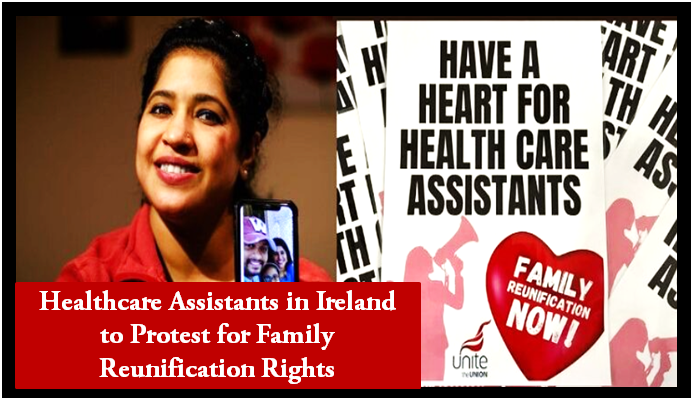
Dublin: As Ireland prepares to celebrate Valentine’s Day, this year holds special significance for overseas healthcare assistants (HCAs) who have long been separated from their loved ones. On February 13, a day before the celebration, HCAs—many of whom are from non-EEA countries, including a significant number of Indians—will gather outside the Department of Enterprise headquarters in Dublin in a protest organised by Unite, one of Ireland’s leading trade unions.
In a press release, Unite announced that the demonstration will take place at 11 a.m. outside the Department of Labour office on Kildare Street, demanding immediate reforms to Ireland’s restrictive family reunification policies. Protesters will highlight the ongoing struggles of HCAs who have been forced to live apart from their families due to stringent income requirements and prolonged visa processing times.
The Department of Employment issued 12,500 work permits to non-EEA migrants in the health and social work sector in 2024, making it the largest sector for work permit approvals. However, despite their significant contributions to Ireland’s healthcare system, many of these workers have been separated from their families for years due to unfair immigration policies.
Struggles Faced by Healthcare Assistants
The majority of affected HCAs are women and mothers who left their home countries in search of better wages and opportunities. However, they now face significant mental, physical, and social challenges due to the separation from their families.
Under Ireland’s current immigration rules, family reunification is dependent on income thresholds, making it nearly impossible for many HCAs to bring their spouses and children to Ireland. While previous income requirements focused on supporting a spouse or partner, new regulations factor in the number of children, further complicating the process.
Visa applications can take up to a year just to be submitted, and the subsequent processing period can stretch over several years. Many HCAs have accused the government of failing to deliver on its promises to reform these restrictive policies.
Repeated Appeals in the Dáil
The issue has been raised multiple times in the Dáil (Irish Parliament). In July 2023, Social Democrat leader Holly Cairns TD and Sinn Féin’s Claire Kerrane TD strongly advocated for reforms in the family reunification system. However, then-Health Minister Stephen Donnelly deferred responsibility to the Department of Justice, which oversees immigration matters.
At the time, HCAs earned too little to qualify for family reunification, even if they had no children. In June 2023, Labour TD Ged Nash proposed an increase in the minimum wage for HCAs from €27,000 to €30,000—a move that was successfully implemented. However, while this salary adjustment now allows HCAs to bring their partners, the higher income threshold for children remains a barrier.
Despite multiple reassurances from government officials, including responses to Labour TD Brendan Howlin last April, meaningful policy changes have yet to be implemented.
A Growing Crisis: Increased Visa Applications
Data from Irish Immigration Services shows that some family reunification visa applications submitted in July 2023 are still being processed, with waiting times ranging between one and two and a half years.
In 2024 alone, the Department of Justice received 22,000 new family visa applications, marking a 14% increase compared to 2023. This surge in applications reflects the growing urgency of the issue. The department, acknowledging these delays, has reportedly increased staffing levels to accelerate processing times.
A government spokesperson stated that family reunification applications for general work permit holders should be processed within 12 months, but critics argue that the backlog and evolving income requirements continue to disrupt the lives of thousands of workers and their families.
Irish Samachar English News
{OR} Kindly click to follow the Irish Samachar News channel on WhatsApp
Comments are closed.