
SCO Summit Highlights Growing Global Challenge to US Influence
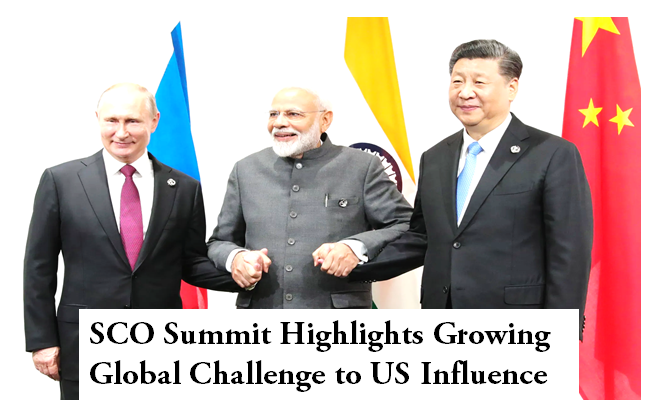
New Delhi: The Shanghai Cooperation Organisation (SCO) summit in Beijing has emerged as a platform showcasing shifting global power dynamics, with several leaders signalling a coordinated challenge to US President Donald Trump’s international policies.
One of the most striking moments came when Russian President Vladimir Putin and Indian Prime Minister Narendra Modi held a 45-minute private conversation inside Putin’s car. Putin’s spokesperson described their discussion as “so natural that they did not even want to get up.” Later, Chinese President Xi Jinping joined them on stage in what observers interpreted as both a gesture of friendship and a deliberate political message.
The summit comes amid heightened tensions between Washington and New Delhi, following Trump’s decision to impose trade tariffs of up to 50% on Indian goods. India has continued purchasing Russian oil and weapons despite US objections, underscoring its refusal to alter strategic priorities under external pressure. Analysts suggest these moves are pushing the United States toward a path of “self-isolation”.
A trilateral meeting between Putin, Xi, and North Korean leader Kim Jong Un further reinforced the image of a consolidated front. Xi’s statement that “domination and the use of force will no longer be tolerated” was widely interpreted as a direct challenge to US leadership.
In Washington, Trump has frequently highlighted his influence, yet international observers argue his foreign policy stance is losing credibility. “The world is no longer listening to Trump; it is moving in a different direction,” remarked European Union officials.
Experts note that the formation of new alliances among China, Russia, India, and North Korea marks a significant geopolitical realignment. Meanwhile, relations between Washington and Brussels remain strained, deepening US isolation on the global stage.
Trump has repeatedly asserted he could end the war in Ukraine “in a single day”, but as other powers step up diplomatic efforts, expectations of him securing a role in any peace process appear increasingly remote.
Domestic critics in the US have also questioned Trump’s approach, with some arguing that the country’s future may lie in alternative leadership, pointing to Vice President J.D. Vance as a figure of rising influence.
Irish Samachar English News
Comments are closed.