
Confidential Report Warns Ireland’s Migration System Is ‘Dysfunctional’ and Requires Urgent Reform
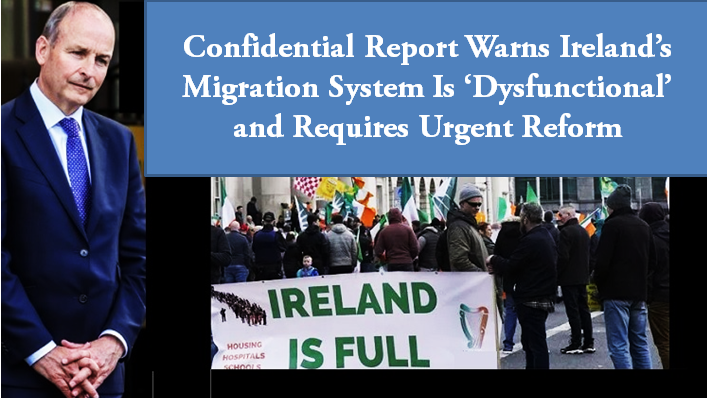
Dublin: A confidential research report prepared for the Taoiseach has warned that Ireland continues to face deep-rooted structural challenges in managing migration, cautioning that many of the country’s current difficulties cannot be resolved quickly.
The report states that while the government advances stricter immigration measures under the Justice Minister, underlying pressures in housing, public services and workforce planning are intensifying. It highlights that several government departments are already struggling with labour shortages across key sectors.
Despite the ongoing housing and accommodation crisis, the research concludes that Ireland will continue to require significant numbers of skilled workers. It stresses that securing a “social licence” — broader public understanding and acceptance of migration policy — is essential for sustainable reform.
System ‘Out of Order’
The report describes the current migration framework as “dysfunctional and inadequate”, warning that it is unrealistic to ignore systemic weaknesses. While acknowledging that all countries have limits on resources and the number of people they can admit, the document argues that failures in meeting citizens’ basic social needs stem from domestic policy shortcomings rather than from migration itself.
It further notes that immigrants play a critical role in sustaining Ireland’s ageing population and workforce. Downplaying or blaming migrants for structural pressures, the report suggests, risks obscuring the real policy challenges.
Workforce and Demographic Pressures
According to the findings, Ireland’s dependency ratio is projected to worsen significantly by 2051. Currently, approximately 2.2 million Irish nationals make up about 80 per cent of the workforce, alongside 565,000 non-Irish workers. Of these, around 308,000 are EU or UK citizens who do not require visas.
The report underscores that key sectors such as healthcare, construction, IT, engineering, science and social care depend heavily on migrant labour. More than 75 per cent of employment permits issued were for individuals with third-level qualifications.
Rising Migration and Policy Gaps
The research identifies 22 distinct migration categories operating within Ireland’s system and estimates that approximately 60,000 people arrive annually — a figure significantly higher than Central Statistics Office projections. It warns that current trends could result in migrant inflows exceeding the state’s capacity to provide adequate housing and public services unless reforms are implemented.
The report concludes that the existing framework is not effectively addressing demographic decline or social infrastructure needs. It calls for more coherent migration management, improved long-term planning, and an open and honest national debate on the country’s future labour and population requirements.
Emphasising that Ireland will continue to need skilled workers regardless of origin, the report states that the State has a responsibility both to protect their rights and to ensure that housing, services and supports are developed to meet the needs of all residents.
Irish Samachar English News
Kindly click to join WhatsApp group chat to get important news and breaking news from Irish Samachar
Comments are closed.