
Saudi Pipeline Shutdown Sends Oil Prices Higher as Middle East Supply Risks Intensify
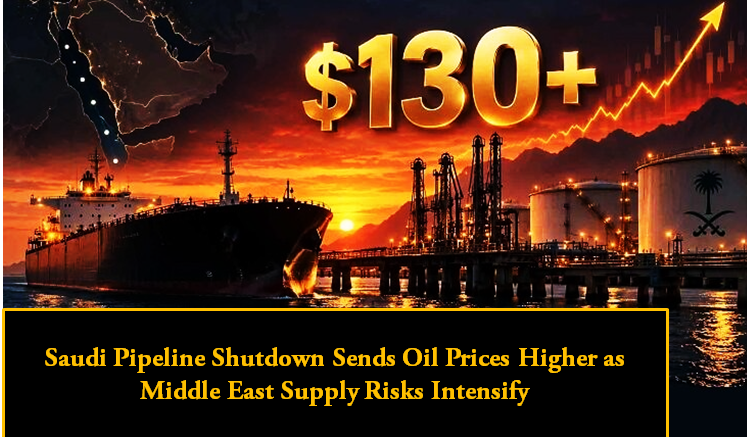
Riyadh: Global oil markets are facing renewed supply concerns after a drone attack forced Saudi Arabia to shut down its strategic East-West oil pipeline, disrupting crude exports through the Red Sea port of Yanbu.
The shutdown comes amid intensifying attacks by Yemen’s Houthi rebels on Saudi targets and continued disruption to shipping through the Strait of Hormuz. The combination of supply and transport risks has pushed oil prices sharply higher and raised concerns about further increases in petrol, diesel and aviation fuel costs.
Brent crude futures recently climbed to around $108 a barrel, while US West Texas Intermediate also recorded significant gains. Physical crude cargoes in Europe have traded at substantially higher levels, with some deals reported at more than $120 a barrel.
Saudi Arabia has also cancelled or suspended some September crude shipments to European customers following the pipeline disruption. Polish refiner Orlen, which receives a significant share of its crude from Saudi Arabia, has been seeking alternative supplies from countries including the United States, Kazakhstan, Algeria and Guyana.
East-West Pipeline a Critical Export Route
The approximately 1,200-kilometre East-West Pipeline links Saudi Arabia’s major oil-producing areas in the east with Yanbu on the Red Sea coast.
The route has become particularly important because it allows Saudi Arabia to bypass the Strait of Hormuz, a vital global oil shipping chokepoint between Iran and Oman.
Before the latest disruption, Saudi Arabia had been routing roughly 4 to 5 million barrels of crude a day through the pipeline, equivalent to about 4 per cent of global oil supply.
The shutdown has also disrupted crude loadings at Yanbu. Industry sources cited by international media estimate that stocks available at the port could sustain exports for only several days if the pipeline remains out of service.
Repairs Could Take Weeks
The Saudi authorities have not provided a definitive timetable for restoring the pipeline. International industry sources have given varying estimates, ranging from several weeks to as long as six weeks or more.
There is also the possibility of partially restarting sections of the pipeline while repair work continues. US Energy Secretary Chris Wright has expressed hope that some operations could resume within days, although industry estimates remain considerably longer for a full restoration.
Saudi Arabia has blamed drones launched from Iraqi territory for the attack and has accused Iran-aligned militias in Iraq of responsibility. No group has publicly claimed responsibility for the strikes, while Iraq has launched an investigation.
The pipeline disruption has occurred alongside a wider escalation in attacks across the region.
Yemen’s Iran-aligned Houthi movement has intensified missile and drone attacks targeting Saudi Arabia and has threatened important oil and shipping infrastructure. The group has also increased pressure around the Red Sea and Bab el-Mandeb, another crucial route for global energy shipments.
The overlapping threats to Saudi oil infrastructure, Red Sea shipping and the Strait of Hormuz have increased concerns about the resilience of global energy supplies.
Could Oil Reach $130?
Some analysts have warned that oil prices could rise considerably further if the Saudi pipeline remains closed for an extended period and shipping through the Strait of Hormuz does not return to normal.
Hamad Hussein, senior climate and commodities economist at Capital Economics, has warned that Brent crude could reach $130 a barrel under a prolonged disruption scenario.
Such figures are scenario estimates rather than firm forecasts and depend heavily on the duration and scale of the supply disruption.
Goldman Sachs has similarly outlined scenarios in which Brent could rise above $120 a barrel if Gulf oil production remains substantially below pre-war levels. These estimates reflect potential worst-case supply conditions rather than guaranteed outcomes.
Strait of Hormuz Traffic Falls
The situation is further complicated by a sharp decline in shipping activity through the Strait of Hormuz.
The strait is one of the world’s most important energy chokepoints, carrying a substantial proportion of global oil and gas shipments. Recent disruptions have reduced tanker traffic significantly, adding to pressure on alternative export routes.
The East-West Pipeline had therefore become an increasingly important alternative for Saudi Arabia, allowing crude to reach the Red Sea without passing through Hormuz. Its shutdown has narrowed the Kingdom’s available export routes at a critical time.
Wider Pressure on Global Fuel Markets
The oil supply concerns extend beyond Saudi Arabia. Russia has also experienced disruptions at several major refineries following drone attacks, putting additional pressure on global refined-fuel markets.
The combined impact of crude supply disruptions, refinery outages and restrictions on major shipping routes could keep pressure on petrol and diesel prices in countries around the world.
If the disruptions persist, higher crude prices could eventually feed through to petrol, diesel, heating fuel and aviation costs, increasing pressure on household budgets and businesses worldwide.
Irish Samachar English News
Comments are closed.