
Netanyahu’s Bloc Leads in Israel Election Count…
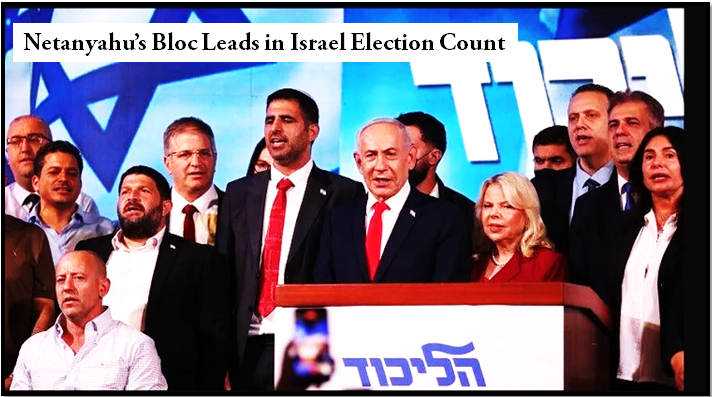
Jerusalem: Israeli Prime Minister Benjamin Netanyahu’s political bloc has emerged ahead in the early vote count following the country’s parliamentary election, raising the possibility of a political comeback despite exit polls suggesting a closely contested race.
Provisional figures released early on Wednesday showed Netanyahu’s bloc projected to win 57 seats, while the main opposition bloc was on 47 seats. Arab-led parties were projected to secure the remaining 16 seats, according to figures cited in the preliminary count.
With 61 seats required for a majority in Israel’s 120-member Knesset, Netanyahu’s bloc remains four seats short of securing power on its own. The figures are provisional, however, and the final outcome could change as counting continues.
The emerging picture differs from some of the exit polls released after voting ended, which suggested that the opposition could prevent Netanyahu’s bloc from securing a majority.
From 63 seats to 57 as counting progresses
The provisional seat projections shifted as more ballots were counted. When 25.2 per cent of ballot boxes had been counted, Netanyahu’s bloc was projected to win 63 seats, giving it a potential parliamentary majority.
As the count progressed to 32.5 per cent, its projected total fell to 59 seats. By the time 41.9 per cent of ballot boxes had been counted, the figure had declined further to 57.
The opposition bloc was projected to win 47 seats, while Arab-led parties were allocated 16 seats in the provisional breakdown.
Although Netanyahu’s bloc remains ahead in these figures, the distribution of seats could change as additional ballots are counted. The early results should therefore not be treated as a final verdict on the election.
Can Netanyahu repeat his 2022 victory?
In the November 1, 2022 election, Netanyahu’s right-wing and religious coalition won 64 seats in the 120-member Knesset, allowing him to return to office.
His Likud party secured 32 seats, making it the largest single party. The coalition also included far-right and religious conservative parties, which helped it establish a parliamentary majority.
The main opposition party at the time, Yair Lapid’s Yesh Atid, won 24 seats.
Israel’s electoral system allocates parliamentary representation through proportional voting, with parties required to secure at least 3.25 per cent of the vote to enter the Knesset. In 2022, the failure of some smaller parties to cross that threshold affected the distribution of seats between the competing blocs.
The performance of smaller parties could again prove decisive in determining which side has a viable path to forming a government.
Exit polls and vote counting offer different pictures
Exit polls published by Israel’s major television networks initially suggested that neither Netanyahu’s bloc nor the main opposition would secure a clear majority.
Updated projections from Kan 11 and Channel 13 placed the two main blocs at approximately 51 seats each. Channel 12 projected 52 seats for Netanyahu’s bloc and 49 for the opposition.
Channel 14, which had offered more favourable projections for Netanyahu’s camp, estimated that his bloc could secure between 60 and 62 seats.
The subsequent partial count appeared to give Netanyahu’s bloc a stronger position than several of the main exit polls had suggested. However, differences between early ballot samples and the final distribution of votes mean that the projections remain subject to change.
The final result will depend on the remaining votes and whether smaller parties cross the electoral threshold.
Special ballots could influence the final outcome
Votes cast by certain categories of voters, including soldiers and other eligible voters using special ballot arrangements, are counted separately from ordinary polling-station ballots.
These votes can affect the final allocation of seats, particularly when parties are close to the electoral threshold. Their impact on the balance between Netanyahu’s bloc and the opposition remains uncertain.
The final party standings will become clearer only when the remaining votes have been counted and the official results are confirmed.
Arab-led parties add another dimension to coalition talks
Arab-led parties were projected to win 16 seats in the partial count, compared with exit-poll estimates of approximately 17 to 19 seats.
Their representation could be important in determining whether either major political bloc can assemble a parliamentary majority. However, the prospect of forming a government with the support of Arab-led parties remains politically contentious among opposition parties.
Consequently, the combined seat totals of the opposition and Arab-led parties do not automatically translate into a viable governing coalition. Their ability to cooperate, and the willingness of individual parties to support a government, will be crucial.
Netanyahu expresses confidence as opposition calls for change
Following the election, Netanyahu called for the formation of a strong right-wing national government and expressed confidence that Likud would remain Israel’s largest party.
The opposition, led by former military chief Gadi Eisenkot, has presented the election as an opportunity for political change and an alternative to Netanyahu’s leadership.
The partial results have strengthened the position of Netanyahu’s supporters, but the absence of a clear majority means that negotiations and political alliances may ultimately determine who forms the next government.
High turnout marks a closely watched election
Voter turnout reached 77.7 per cent, the highest reported level since 1999, according to the figures released by the Central Elections Committee.
The election was shaped by concerns over national security, the consequences of the Gaza war, tensions involving Iran, economic pressures and Netanyahu’s political future.
With Netanyahu’s bloc provisionally projected to hold 57 seats, the central question is whether it can secure the four additional seats needed for a majority or whether the opposition and Arab-led parties can find a workable alternative.
As counting continues, Israel and the international community are watching closely to see how the final results will reshape the country’s political landscape.
Irish Samachar English News