
HSE Leadership Crisis Deepens After Anne O’Connor’s Dismissal Amid Cork Hospital Staffing Dispute
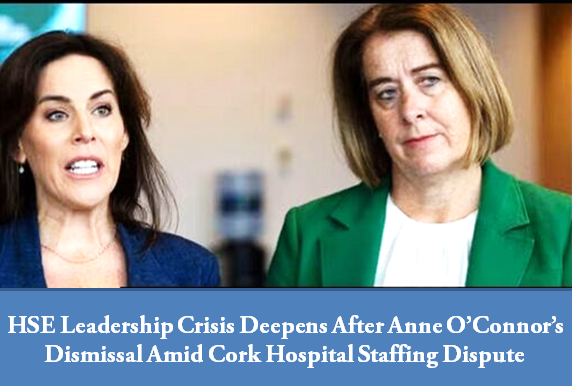
Dublin: A dispute over staff shortages at Cork University Hospital has escalated into a major leadership and governance crisis within Ireland’s health service. The dismissal of Health Service Executive (HSE) chief executive Anne O’Connor from her position on Monday has reignited national debate over recruitment restrictions, hospital staffing levels and patient safety.
O’Connor’s departure comes less than a year after she took up the position, which carries an annual salary of approximately €400,000. The HSE Board said it had decided to end her tenure after concluding that the move would be in the best interests of the organisation’s future operations. However, it did not disclose the specific reasons behind the decision.
The controversy began in Cork: Who will protect patients without sufficient staff?
The dispute can be traced back to serious concerns raised last August by Jennifer Kearney, chief executive of Cork University Hospital.
Kearney warned that the hospital was facing a staffing shortage of approximately 1,000 employees and that continuing to operate without sufficient recruitment could put patient safety at risk. She argued that the existing workforce would struggle to maintain safe services, particularly as patient numbers were expected to increase during the winter months.
However, financial and administrative restrictions made it difficult for the hospital to recruit the additional staff it considered necessary. The growing conflict between the hospital’s operational requirements and the HSE’s financial controls soon developed into a wider dispute.
Andy Phillips’ intervention sparks controversy
The involvement of Dr Andy Phillips, the HSE South West Regional Executive Officer responsible for health services in Cork and Kerry, significantly escalated the situation.
During a meeting with hospital management last August, Phillips reportedly claimed that he was acting on instructions from the offices of Taoiseach Micheál Martin and Health Minister Jennifer Carroll MacNeill.
His remarks triggered allegations that the names of senior political leaders had been invoked to put pressure on hospital management after it raised concerns about staffing shortages and patient safety.
The controversy intensified after a recording of the meeting became public. Both the Taoiseach and the Health Minister subsequently clarified that no such instructions had been issued from their offices.
On November 7, Phillips withdrew his earlier statement and issued an unconditional apology.
Anne O’Connor’s defence of Phillips raises further questions
Many expected the controversy to subside following Phillips’ apology. However, the position taken by HSE chief executive Anne O’Connor opened a new chapter in the dispute.
In an interview with RTÉ on November 15, O’Connor said she continued to have confidence in Phillips. She suggested that his comments had to be understood in the context of the circumstances surrounding the meeting.
She also questioned the circumstances in which the meeting had been recorded and criticised the working relationship and cooperation within Cork University Hospital’s management.
Her comments prompted criticism that the HSE leadership appeared to be supporting the regional executive rather than directly addressing the concerns raised by the hospital’s chief executive.
Questions raised before the parliamentary committee
O’Connor appeared before the Oireachtas Health Committee on November 18, where members sought explanations about the handling of the dispute.
However, she did not provide a clear response when questioned about whether she continued to have full confidence in Phillips.
More strikingly, O’Connor revealed that she had not spoken to Jennifer Kearney, the chief executive of Cork University Hospital, since September, despite the seriousness of the staffing and patient safety concerns.
This prompted criticism that the head of the national health service had failed to engage directly with the leader of a major hospital after she raised warnings about its ability to provide safe care.
Five days after her appearance before the committee, the HSE Board announced its decision to terminate O’Connor’s tenure.
One of the most striking aspects of the controversy is that Phillips, whose remarks triggered the dispute, remains in his position, while his superior, O’Connor, has been removed.
Staffing crisis extends beyond Cork
The crisis is not confined to Cork University Hospital. Hospitals across Ireland, including those in Dublin, Limerick, Galway and Waterford, face ongoing challenges in matching staffing levels with growing demand for healthcare services.
Although the scale of shortages varies between hospitals, recruiting and retaining sufficient staff in emergency departments, older-person care, mental health services and community healthcare remains a significant challenge.
Long waits for treatment on hospital trolleys, extensive surgical waiting lists and increasing pressure on healthcare workers are all symptoms of the wider difficulties facing the health service.
Ireland’s growing population, ageing demographic and rising demand for medical care are increasing the need for additional healthcare professionals.
Hospitals need more staff, but recruitment restrictions remain
Despite growing calls to address staffing shortages, strict financial oversight has been introduced for new recruitment as part of efforts to control HSE spending.
Financial controls and additional approval requirements have been strengthened in four of the country’s six health regions: Dublin and South East, Dublin and Midlands, South West, and West and North West.
Although the HSE has not officially announced a complete recruitment freeze, hospitals face additional scrutiny when seeking approval to create new positions, fill vacant posts or introduce promotions.
The requirement for further financial assessments and authorisation has reportedly slowed recruitment, even as hospitals warn that existing staffing levels are insufficient to meet patient needs.
This has created a difficult situation in which healthcare facilities are under pressure to provide more services while facing restrictions on expanding their workforce.
Indian nurses caught in recruitment uncertainty
The HSE’s recruitment restrictions are also affecting nurses from India who are seeking employment in Ireland.
Candidates who have completed initial interviews, as well as those at various stages of the recruitment process, are facing uncertainty over when appointments will be approved.
Although Irish hospitals continue to require nursing staff, recruitment depends on the availability of approved vacancies and the necessary financial authorisation.
Indian nurses awaiting progress on their applications are hoping that the change in HSE leadership could lead to a review of the current restrictions. However, no new announcement has been made regarding a possible relaxation of recruitment controls.
Additional healthcare spending puts pressure on Government
The HSE’s financial management is another major challenge for the government. The organisation operates with an annual budget of approximately €29 billion, and controlling expenditure while meeting rising healthcare demands remains difficult.
Last week, the Cabinet approved an additional €780 million in funding to meet rising costs in the health sector.
The government is therefore facing competing demands: controlling public expenditure while ensuring that hospitals have enough staff to maintain patient safety and deliver essential services.
How the new HSE leadership balances these financial constraints with the urgent need for recruitment is likely to be a key test in the coming months.
O’Connor considers legal action over dismissal
Following her removal, Anne O’Connor challenged the fairness of the decision, arguing that the procedures followed were neither fair nor transparent.
She said she would consider all available options to contest the action and protect her professional reputation.
The HSE Board’s decision has also attracted criticism from within the healthcare sector. The Irish Hospital Consultants Association has called for the resignation of the HSE Board.
Deputy Chief Executive Damien McCallion is expected to take over as interim chief executive.
Further developments are anticipated when Andy Phillips and Jennifer Kearney are due to appear before the Oireachtas Public Accounts Committee on December 3.
Irish Samachar English News