
Sharp Contraction in Irish Economy Drags Eurozone into Unexpected Slowdown, Eurostat Reports
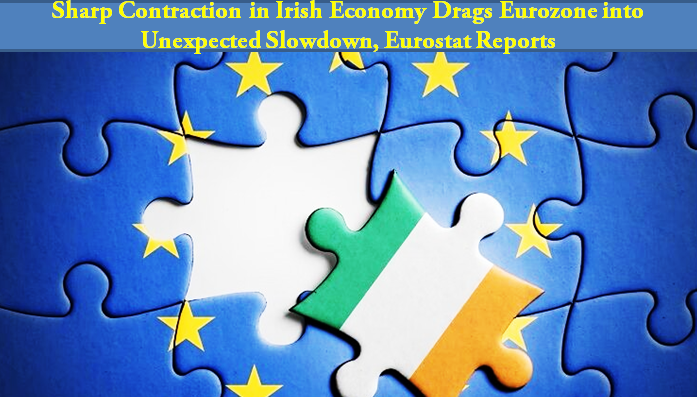
Dublin: Ireland’s economic performance has significantly weighed on the wider eurozone economy, with new figures from the EU’s statistics agency showing that the euro area unexpectedly contracted during the first quarter of the year.
According to Eurostat, the eurozone economy shrank by 0.2% in the first quarter, reversing earlier expectations of modest growth of around 0.1%. The agency said a substantial downward revision to Ireland’s economic data was a major factor behind the unexpected decline across the 21-member currency bloc.
Irish GDP Revised Sharply Downward
Ireland’s economic activity contracted far more sharply than initially estimated. Earlier figures had suggested a decline of around 2%, but revised data now indicate that Irish GDP fell by 12.1% during the quarter.
The Central Statistics Office (CSO) said the significant revision reflected updated information relating to multinational corporations, whose activities can have a substantial impact on Ireland’s headline economic figures.
French Economy Also Weakens
Economic performance in France, the eurozone’s second-largest economy, also deteriorated during the period. French GDP declined by 0.1%, adding further pressure to overall eurozone growth.
However, economists note that Ireland’s unique economic structure can often distort broader eurozone data.
According to Rory Fennessy, economist at Oxford Economics, the underlying picture across the eurozone remains relatively stable when Ireland’s volatile GDP figures are excluded.
“Excluding Ireland, eurozone growth remained broadly steady at around 0.2% per quarter,” Fennessy noted.
Middle East Conflict Adds New Economic Risks
Despite the relatively stable underlying growth, economists warn that rising geopolitical tensions and energy market disruptions are creating fresh challenges for the European economy.
The ongoing conflict in the Middle East and the resulting increase in energy prices are expected to place additional pressure on businesses and consumers across the region. Higher energy costs are also likely to fuel inflation and weaken economic activity in the coming months.
Fennessy warned that the full impact of the energy shock has yet to be felt and suggested that economic conditions could deteriorate further during the second quarter.
Irish Samachar English News
Comments are closed.