
ESRI Warns of Structural Shifts and Funding Pressures in Ireland’s Nursing Home Sector
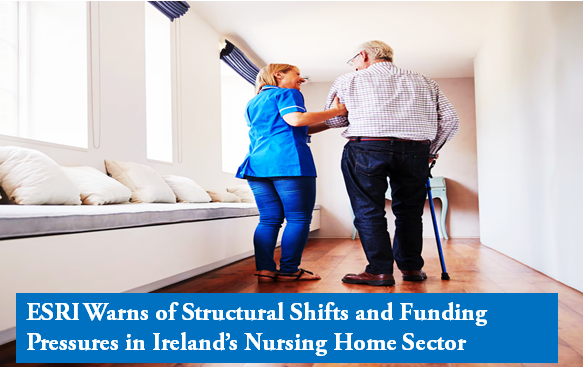
Dublin: The Economic and Social Research Institute (ESRI) has published a major report examining how Ireland’s long-term residential care sector has evolved since the Covid-19 pandemic, highlighting significant changes in ownership, funding pressures and regional inequalities.
The report finds that almost three-quarters of Ireland’s private nursing homes are now owned by large private operators, with private equity–backed real estate investment trusts (REITs) playing an increasingly dominant role. Fourteen major private operators currently account for around 40% of the national nursing home market. By contrast, facilities owned by independent family groups and institutions, which once dominated the sector, now account for just 35% of nursing homes nationwide.
According to the ESRI, the growing presence of private equity–funded operators has made the sector more closely linked to broader economic conditions and international investment trends.
A shift in ownership models
Traditionally, nursing homes in Ireland were owned and operated by the same family or institution. The report notes that this model has changed significantly. Under the newer structure, nursing homes are often owned by real estate companies and leased to separate operating firms. These arrangements can involve REITs that benefit from tax incentives, while care delivery, regulation, staffing and ownership are managed by distinct entities.
The ESRI stresses that these structural changes require close regulatory oversight to ensure accountability and compliance with care standards.
Sustainability and capacity challenges
The report underlines the need for a sustainable long-term care system for Ireland’s ageing population. While consolidation and investment have occurred, progress has been constrained by rising costs and funding challenges. The ESRI warns that without fresh investment, the number of nursing home beds cannot increase significantly, and relatively few new projects are currently planned.
The Health Information and Quality Authority (HIQA) continues to carry out regular inspections of nursing homes, but the ESRI recommends urgent reform to ensure full compliance with regulatory, financial and care obligations across the sector.
Fair Deal funding disparities
Significant disparities in Fair Deal funding are also highlighted. The ESRI reports that the average cost of a Fair Deal-funded bed in public nursing homes is approximately 55% higher than in voluntary or private facilities. It also notes that Fair Deal payments have not kept pace with inflation and that nursing homes in Dublin and surrounding commuter counties receive higher per-capita funding than those in rural areas.
Impact of Covid-19 and government support
The report emphasises that government intervention was critical in sustaining the sector during the pandemic, when nursing homes experienced high infection and mortality rates. Increased costs linked to staff shortages, enhanced cleaning and infection control placed severe financial strain on providers. To address this, the government introduced the Temporary Assistance Payment Scheme (TAPS), providing more than €32 million in financial support.
Closures and regional inequalities
Many smaller nursing homes, particularly in rural areas, closed during or after the pandemic, contributing to a national shortage of beds. While bed numbers increased most in Dublin and surrounding counties, regions such as Portlaoise, Sligo, Donegal, Monaghan, Kerry and Leitrim recorded the lowest per-capita supply. The ESRI warns that these regional disparities are likely to widen without targeted intervention.
Expert panel recommendations
The report draws on the findings of the Nursing Homes Expert Panel, which has advised the Minister for Health on the future of long-term residential care. The panel has emphasised the importance of expanding home-based care options, which could reduce reliance on nursing homes and change the profile and needs of residents who require residential care.
Aligning financial incentives with the health and social care needs of residents is identified as essential to the sector’s long-term sustainability.
Concerns over ownership transparency
The ESRI report has also renewed public debate around transparency in nursing home ownership, particularly where private equity and international investment are involved. While the report itself does not substantiate allegations of wrongdoing, it notes that clearer governance, ownership disclosure and workforce protections are necessary to maintain public confidence and safeguard staff and residents.
Irish Samachar English News
Kindly click to join WhatsApp group chat to get important news and breaking news from Irish Samachar
Comments are closed.