
68% of Young Adults Consider Leaving Ireland as Housing and Cost-of-Living Pressures Mount
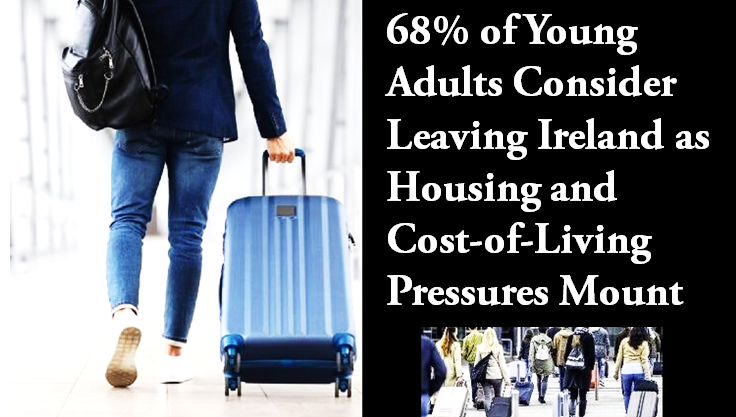
Dublin: For many young people, the traditional ambition of getting an education, finding a good job and building an independent life at home is becoming increasingly difficult to achieve in Ireland.
New research by the National Youth Council of Ireland (NYCI) highlights the scale of that concern. A RED C poll commissioned by the NYCI found that 68 per cent of 18- to 24-year-olds are considering moving abroad, while 71 per cent believe they would have a better quality of life outside Ireland.
The figures do not mean that 68 per cent of young people are preparing to leave the country. Rather, they show the extent to which emigration is being considered as an option by a generation facing significant pressures around housing, employment and the cost of living.
“Will I Be Able to Afford a Home?”
Housing remains one of the central concerns identified in the survey.
89 per cent of young adults said the housing crisis disproportionately affects younger people. Around nine in ten also said they had been negatively affected by the rising cost of living, while a similar proportion said it is becoming increasingly difficult to find secure, well-paid employment.
For many young workers, the challenge is therefore not simply finding employment but determining whether a salary will allow them to live independently after paying rent, transport costs and other household expenses.
Concerns about mental health, transport costs and the impact of artificial intelligence on future employment are also part of the wider picture.
The NYCI research found that more than seven in ten adults believe AI could make it harder for young people to secure employment over the next five years.
Housing Pressures Affect Young People and Migrants
The pressures highlighted by the survey are not confined to Irish-born young people.
Rising rents, the cost of living and difficulties accessing suitable housing can also affect migrants living and working in Ireland. Some migrants face additional challenges involving employment permits, immigration status and family reunification.
At the same time, migrants make an important contribution to sectors including healthcare, transport, hospitality and other areas of the Irish economy.
The debate over youth emigration and migration therefore involves two separate questions: how Ireland can create conditions that allow young people to remain and build independent lives, and how the country can manage immigration and provide opportunities for people who come to live and work here.
Population Growth Requires Infrastructure
Ireland’s population has increased substantially in recent years.
The island also has a very different population profile from the period before the Great Famine. The 1841 Census recorded more than 6.5 million people in the area that now comprises the Republic of Ireland.
However, comparisons between 1841 and today need to be made carefully because Ireland’s political boundaries, economy, infrastructure and demographic circumstances have changed significantly.
Population growth by itself is not a solution to Ireland’s challenges. More people also require sufficient housing, schools, healthcare services, transport infrastructure and employment opportunities.
The latest NYCI research has prompted renewed discussion about the conditions facing young people ahead of Budget 2027. The organisation is calling for measures addressing the cost of living, youth homelessness, employment, transport and education costs.
The debate over immigration has also become increasingly prominent in Ireland. However, attributing the housing crisis or cost-of-living pressures to migrants alone does not address the wider range of factors affecting housing supply, affordability, infrastructure and public services.
The challenge for policymakers is to address those pressures while maintaining an economy and society in which both existing residents and newcomers can build sustainable lives.
For a young person who feels that leaving Ireland is the only realistic way to achieve financial independence, the central question is whether conditions can change enough to make staying an attractive option.
Equally, people who move to Ireland to work, study or build a family will also want the opportunity to establish a secure future.
Ireland’s long-term challenge is therefore not simply to prevent young people from leaving or to manage migration. It is to create the housing, employment, public services and infrastructure needed to make the country a place where people who grow up here — and those who later make Ireland their home — can build sustainable futures.
Irish Samachar English News