
India–EU Free Trade Agreement Set for Formal Announcement
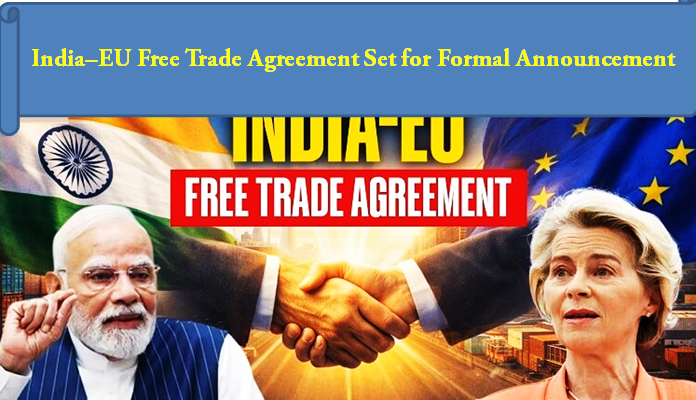
Dublin: New Delhi is preparing for the formal announcement of a landmark Free Trade Agreement (FTA) between India and the European Union, marking a major step forward in bilateral economic relations.
European Commission President Ursula von der Leyen, speaking at the World Economic Forum, said the historic agreement—negotiations for which began in 2007—is expected to be ratified on January 27, in the presence of representatives from all 27 EU member states. While some technical work remains, she described the deal as transformative, covering a combined market of nearly two billion people and representing close to a quarter of global GDP.
Key Features of the India–EU Trade Deal
Tariff Reductions:
A central element of the agreement is the significant reduction of import and export duties, easing market access for industrial goods, vehicles, machinery, textiles, and pharmaceuticals on both sides.
Services Sector Access:
The FTA places strong emphasis on services, particularly IT, digital services, financial services, and professional services, improving European market access for Indian providers while opening new opportunities for EU firms in India.
Investment Protection:
Provisions aim to ensure a stable and predictable investment environment, offering stronger legal safeguards for European investments in India and facilitating Indian investments across Europe.
Digital Trade and Data Protection:
The agreement addresses e-commerce, cross-border data flows, cybersecurity, and consumer data protection, reflecting the growing importance of the digital economy.
Intellectual Property Rights:
Enhanced protection for patents, trademarks, and Geographical Indications (GIs) is expected to boost innovation and promote Indian traditional products in European markets.
Environment and Labour Standards:
Commitments include climate action, carbon reduction, clean energy use, and the protection of workers’ rights, including fair wages, safe working conditions, and adherence to international labour standards.
Sustainable Development:
The overarching goal is long-term, sustainable economic growth through cooperation in green energy, clean technology, and environmentally responsible industries.
Benefits for India
According to the Global Trade Research Initiative (GTRI), India’s exports to the EU—currently valued at around $76 billion—would face an average tariff of just 3.8 percent in FY2025, though some sectors such as garments may continue to face higher duties. Removing these tariffs would significantly benefit labour-intensive industries, including textiles, leather goods, and footwear, while restoring competitiveness lost after the withdrawal of EU trade preferences.
The agreement is also expected to help Indian exporters offset the impact of tariffs imposed by the United States and reduce overreliance on the US market, particularly by expanding opportunities in skill-intensive services.
EU Objectives
For the European Union, the deal opens access to India’s vast and growing consumer market of over 1.4 billion people. European exporters are likely to gain in sectors such as aviation, electrical machinery, chemicals, diamonds, and high-value manufactured goods, while service providers in IT, telecommunications, and business services stand to benefit from clearer rules and stronger investment protections.
Impact on the Indian Diaspora in Europe
The FTA is expected to create new job opportunities for Indian professionals, especially in IT, engineering, finance, research, and digital services. Indian companies and start-ups in Europe are likely to expand operations, improving career prospects and earning potential for expatriates.
Stronger labour protections and investment safeguards could also encourage entrepreneurship within the Indian diaspora, while the broader economic boost from increased India–EU trade is expected to enhance employment stability, financial security, and long-term residency prospects across Europe.
Irish Samachar English News
Kindly click to join WhatsApp group chat to get important news and breaking news from Irish Samachar
Comments are closed.