
Ireland Clarifies EU–India Trade Deal Will Not Grant Automatic Work or Residency Rights to Indian Citizens
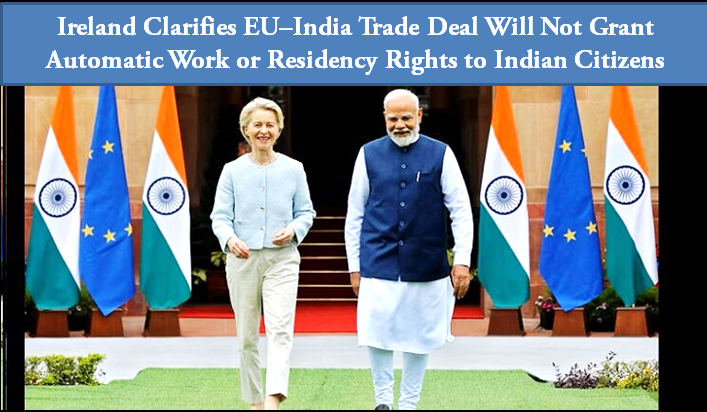
Dublin: The Irish Department of Justice has clarified that the proposed European Union–India Free Trade Agreement (FTA) will not allow Indian citizens to freely move to Ireland or take up employment automatically. The Department confirmed that Ireland will not participate in the proposed labour mobility arrangements linked to the agreement.
While the trade deal is expected to create significant economic opportunities for businesses in both India and the European Union, Ireland has made it clear that its existing immigration and employment permit rules will remain unchanged.
Ireland Opts Out of Labour Mobility Scheme
The Department of Justice said Ireland will not join the voluntary labour mobility framework proposed alongside the EU–India trade agreement.
Although the scheme aims to facilitate the movement of students, researchers, IT professionals and skilled workers by providing information and support for employment opportunities across Europe, participation is optional for EU member states. Ireland has decided not to take part, while several other European countries are expected to participate.
The Department stressed that the trade agreement does not create any obligation for Ireland to admit Indian workers or grant them special immigration rights.
Trade Agreement Yet to Take Effect
Negotiations on the EU–India Free Trade Agreement concluded earlier this year, but the agreement has not yet entered into force.
Before implementation, it must undergo legal review, receive approval from the European Parliament, be ratified by EU member states, and complete India’s domestic approval process. The agreement is widely expected to come into force in early 2027, although no official implementation date has been announced.
Once operational, it will become one of the world’s largest trade agreements, connecting more than 1.4 billion people in India with around 450 million consumers across the European Union.
Trade and Immigration Are Separate
Irish officials emphasised that the trade agreement and labour mobility arrangements are separate mechanisms.
The FTA is designed primarily to reduce trade barriers and facilitate the movement of goods and services, while the proposed mobility framework focuses on supporting cooperation between professionals, researchers, students and skilled workers.
Ireland’s decision not to participate means that existing immigration rules will continue to apply.
No Changes to Irish Work Permit Rules
Indian nationals seeking employment in Ireland will still need to use the existing legal immigration pathways, including:
-
Critical Skills Employment Permit
-
General Employment Permit
-
Student Visa
-
Dependant and other authorised employment schemes
The Department reiterated that signing a trade agreement does not confer any automatic right to work or reside in Ireland. A valid visa, employment permit and immigration permission will continue to be mandatory.
However, the agreement could make short-term business travel easier for certain categories of professionals, including employees transferred within multinational companies, contractual service providers and business visitors.
Major Opportunities for Indian Exporters
If implemented, the agreement is expected to eliminate or significantly reduce tariffs on many Indian exports to the European Union.
Sectors expected to benefit include:
-
Textiles and garments
-
Footwear
-
Leather products
-
Seafood
-
Jewellery
-
Pharmaceuticals
-
Sports goods
-
IT and software services
-
Professional services
-
Education and research
The agreement is expected to create new export opportunities and generate additional employment for Indian businesses serving European markets.
Greater Access to India’s Market for Irish Businesses
Ireland is also expected to benefit substantially from improved access to the Indian market.
Industries likely to gain include:
-
Irish whiskey
-
Pharmaceuticals
-
Medical devices
-
Technology and software
-
Fintech
-
Aviation services
-
Higher education
A phased reduction in India’s import duties on Irish whiskey is expected to significantly improve market access for Irish producers. The agreement could also benefit multinational pharmaceutical, medical technology and technology companies with operations in Ireland.
Potential Challenges
While the agreement is expected to strengthen economic ties, it could also increase competition in certain sectors.
Greater access for Indian IT companies and professional service providers could intensify competition for Irish firms operating in those industries. Similarly, lower-cost imports of products such as clothing, footwear and generic medicines may place pressure on some domestic suppliers, although consumers could benefit from lower prices.
Ireland’s decision not to participate in the voluntary labour mobility scheme may also place it at a disadvantage compared with countries such as Germany and France if they use the programme to attract highly skilled Indian professionals.
Nevertheless, Ireland retains full authority to recruit skilled workers from India through its existing employment permit system whenever labour market needs arise.
Irish Samachar English News
Comments are closed.