
Ireland’s Nursing Workforce Increasingly Reliant on International Recruits, Study Finds
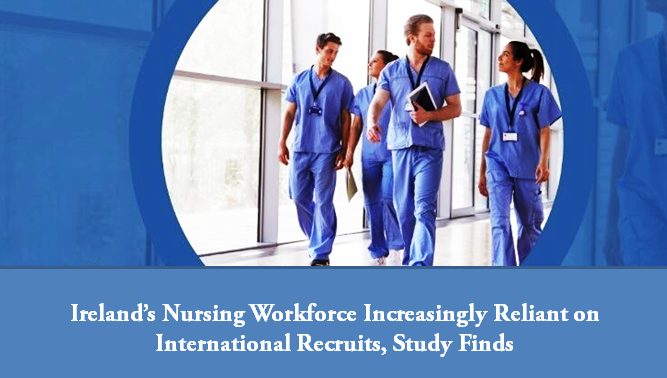
Dublin: More than half of nurses working in Ireland are now from overseas, reflecting a long-term shift in the country’s healthcare workforce, according to new research by the Royal College of Surgeons in Ireland (RCSI).
The study found that 61% of new entrants to the nursing profession in 2022 were trained outside the European Union, while over 50% of all nurses registered between 2003 and 2022 migrated from abroad. The findings underscore Ireland’s growing dependence on internationally trained healthcare professionals.
Historically, Irish nurses formed a significant part of the workforce in the UK’s National Health Service during the latter half of the 20th century, with tens of thousands emigrating to Britain. In recent decades, however, Ireland has increasingly relied on nurses from countries such as India, the Philippines, and African nations including Zimbabwe, Nigeria, and Ghana.
The research attributes this shift to persistent shortages of domestically trained staff, leading to sustained international recruitment. The analysis draws on data from the Nursing and Midwifery Board of Ireland, RCSI’s Faculty of Nursing and Midwifery, and the Central Statistics Office.
Changing Workforce Trends
The number of nurses trained outside the EU has increased significantly, rising from 832 in 2003 to 3,879 in 2022—more than a fourfold increase. In contrast, EU-trained nurse registrations peaked at 1,748 in 2017 before falling sharply to just 124 in 2022. By that year, EU nurses accounted for only 7.3% of new registrations.
Meanwhile, the number of Irish-trained nurses registering declined from 1,787 in 2003 to 1,521 in 2022. Despite these changes, the overall number of nurses relative to the population has remained relatively stable, increasing only slightly from 14.77 per 1,000 people in 2003 to 14.88 in 2022.
Structural Dependence on Migrant Nurses
Comfort Chima, one of the study’s lead authors and a tutor at RCSI’s School of Nursing and Midwifery, noted that Ireland’s healthcare system has depended heavily on migrant nurses for more than two decades. She said this trend reflects gaps in domestic training capacity, retention strategies, and long-term workforce planning.
While migrant nurses play a critical role in maintaining patient care, the report emphasises the need for stronger investment in local nurse education, improved retention measures, and coordinated national workforce strategies to ensure stability.
Persistent Shortages Despite Recruitment
Despite sustained international recruitment, Ireland continues to face a significant nursing shortage. The study attributes this to an ageing population, rising life expectancy, and increasing demand for care, particularly in nursing homes.
Historically, Irish nurses migrated to countries such as the United Kingdom, the United States, and Canada. However, since the 1990s, Ireland has experienced an acute shortage of nursing staff, reversing previous migration patterns and increasing reliance on overseas recruitment.
Irish Samachar English News
Comments are closed.