
Growing Fear and Frustration Among Indian Community in Ireland After Violent Attack in Tallaght
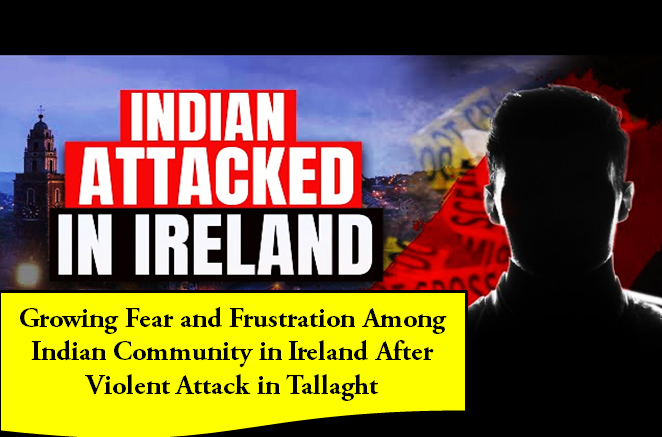
Dublin – A brutal assault on an Indian youth in Parkhill Lawns, Tallaght, Kilmany, has sparked widespread outrage and deep concern among Ireland’s Indian community and human rights advocates. The young man, who arrived in Ireland to work with Amazon, was stripped naked and physically assaulted by a gang, an incident that has left him in severe psychological distress.
Though the victim was the only one physically harmed, the emotional shockwaves from the attack have reverberated through Irish society, especially among Indian nationals and peace advocates who are now questioning the state’s response and commitment to safety and justice.
Indian Embassy Issues Safety Advisory Amid Rising Attacks
In light of rising physical assaults, the Indian Embassy in Ireland has issued a safety advisory to Indian-origin residents, urging them to remain vigilant and avoid travelling through deserted areas, particularly at odd hours. The embassy also confirmed it is in active communication with Irish authorities to ensure the safety of its citizens.
However, the lack of arrests in the Tallaght attack—allegedly perpetrated by a 13-member gang—has alarmed community leaders. Many are questioning the authorities’ silence and inaction.
Public Concern Grows Over Lack of Accountability
The absence of arrests has raised serious concerns among peace activists and civil society groups. Questions are being asked:
- Why haven’t any of the attackers been detained?
- Are the attackers being shielded, or is there a deeper motive behind such targeted violence?
- Why are Indian nationals increasingly becoming victims of such aggression?
Eyewitness accounts suggest that the assailants were recording videos of their attacks on Indian individuals—adding a disturbing layer to an already shocking crime. Despite the availability of CCTV footage and digital evidence, no suspects have been brought to justice.
Attack Raises Broader Questions on Racism, Security, and Responsibility
This attack is not an isolated event. It follows a pattern of increasing hostility and targeted violence, with social media circulating footage of other racially motivated incidents, including an earlier assault on a teenager aboard a Dublin bus.
The Indian community in Ireland is no longer willing to remain silent. There is mounting pressure on the Irish government and law enforcement agencies to act decisively, both to prevent future attacks and to reassure immigrant communities that their safety is a priority.
Indians in Ireland: Contributors, Not Intruders
Today, over tens of thousands of Indians live in Ireland, many of whom are naturalised citizens. The vast majority contribute meaningfully to the economy and public services:
- Thousands are employed as healthcare workers, nurses, and doctors.
- Others are part of Ireland’s IT, finance, and service sectors.
- Each year, 7,000–9,000 Indian students arrive in Ireland, contributing over €200 million in tuition and living expenses to the local economy.
These contributions were not charity. Indians were actively invited to fill shortages in Ireland’s labour market, and their role in the functioning of the country is indispensable.
A Shared History, A Shared Responsibility
Historically, Ireland and India share a legacy of colonial resistance and mutual respect. Irish nationals such as Annie Besant, Sister Nivedita, and Margaret Cousins played pivotal roles in India’s freedom struggle. In turn, thousands of Irishmen came to India seeking livelihoods, serving in both civilian and military roles under British rule.
This shared history makes recent developments all the more tragic—and, for many, unacceptable.
Time for Structural Action, Not Symbolic Gestures
Community leaders are calling for urgent reforms and support mechanisms:
- 24/7 community helplines, legal aid, and trauma counselling services.
- Dedicated embassy support cells to assist victims of hate crimes.
- Rapid police response teams and public accountability for investigations.
- Public tracking of hate crime prosecutions and enhanced community policing.
The government must also reconsider laws that may prevent law enforcement from effectively handling juvenile offenders involved in such serious crimes.
A Crisis of Confidence in Safety and Justice
The growing fear is not just about the attackers but about the state’s inaction. Social media posts, including one from an Indian nurse preparing to leave Ireland, reflect a deepening sense of insecurity. The nurse works in a sector where Indian professionals form the backbone of elderly care and hospital services.
The fear is now systemic. It has less to do with sporadic violence and more to do with the government’s silence, the police’s ineffectiveness, and the embassy’s cautious diplomacy.
A Call to Restore Faith
Ireland must act—decisively, swiftly, and justly. Until the perpetrators of the Tallaght attack are arrested and prosecuted, this fear will remain. If foreign nationals, especially those who are invited to contribute to a country’s economy and social fabric, cannot be assured of basic security, the consequences will be dire—not just for immigrants, but for Ireland’s international standing.
Peace, justice, and dignity must not be optional values. For the Indian community in Ireland, it’s time those ideals were reflected in action—not just words.
Irish Samachar English News
{OR} Kindly click to follow the Irish Samachar News channel on WhatsApp
Comments are closed.