
EU Proposes Strict New Digital Laws to Protect Children, Raise Social Media Age to 16
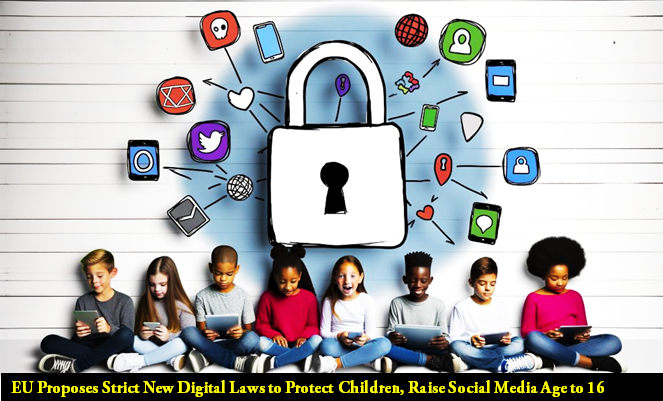
Brussels: The European Parliament is calling for sweeping reforms to regulate children’s use of social media, proposing to raise the minimum age of independent access to 16 years across the EU. The move forms part of a broader overhaul of EU digital laws aimed at safeguarding minors online.
Under the proposed framework, children aged 13 to 16 would require parental consent to access social media platforms, video-sharing sites, and AI-based companion tools. The reforms draw inspiration from Australia’s stringent child online safety model.
Major Changes for Social Media Platforms
MEPs are seeking to ban or restrict several platform features deemed harmful or addictive for children. These include:
- Infinite scrolling
- Reward loops
- Gamified engagement tactics
- Dark patterns and manipulative interface designs
- Targeted advertising and influencer-driven promotions
The proposed Digital Fairness Act would enforce strict oversight of addictive design, advertising practices, and user manipulation.
Restrictions on Gambling-Like Features
The legislation aims to prohibit:
- Loot boxes
- Fortune wheels
- In-app currencies
- Pay-to-progress systems
These changes target mechanisms that mimic gambling behaviour and exploit young users.
Controls on Generative AI
The law also seeks to address emerging risks from AI tools, including:
- Deepfakes
- AI chatbots and companion tools
- AI-generated nudity apps
- Autonomous AI agents
Strengthening Protection Against Child Sexual Abuse
Digital companies would be legally required to prevent and remove child sexual abuse material (CSAM). EU member states would gain expanded powers to:
- Order immediate removal of illegal content
- Block access to sites hosting harmful material
A new national-support agency, the EU Centre on Child Sexual Abuse, would guide governments and online providers.
EU-Wide Age Verification System
To enforce the age limits, the EU plans to develop:
- An EU age-verification app
- A digital identity wallet
These tools must protect minors’ privacy and ensure robust, tamper-proof verification. MEPs insist senior tech executives—including Mark Zuckerberg and Elon Musk—should be personally accountable for compliance.
Non-Compliant Platforms Could Be Banned
The Parliament warns that platforms failing to comply with the new standards could face EU-wide bans.
“Social media platforms were not designed for children—this experiment must end,” said European Parliament Vice-President and rapporteur Christel Schaldemose.
Irish Samachar English News
Kindly click to join WhatsApp group chat to get important news and breaking news from Irish Samachar
Comments are closed.