
ESRI Warns Food Prices Will Rise Further This Year
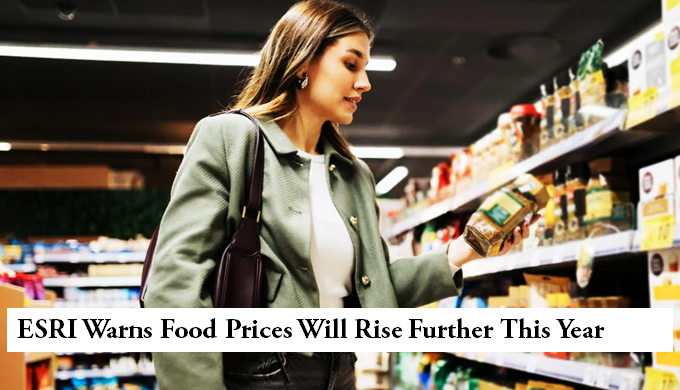
Dublin: Irish households are likely to face higher grocery bills by the end of the year as rising fuel and energy costs continue to drive inflation, according to the latest quarterly economic report from the Economic and Social Research Institute (ESRI).
The report warns that increasing energy prices are expected to trigger a second-round impact on consumer prices during the autumn and winter, leading to higher food costs. The ESRI said low- and middle-income households are likely to be the hardest hit and may require additional government support.
The institute has also revised its inflation outlook, forecasting inflation of 3.7% in 2026, easing to 3.1% in 2027.
Economic Growth Outlook Improved
Despite inflationary pressures, the ESRI has upgraded its forecast for Modified Domestic Demand (MDD)—a key measure of Ireland’s underlying economic activity—to 2.6% in 2026.
The improved outlook reflects stronger-than-expected housing construction and increased investment in artificial intelligence, data centres and advanced technology infrastructure.
However, the report cautions that continued uncertainty surrounding global fossil fuel prices and the conflict in the Middle East could weigh on the economy.
Fuel Support Measures Criticised
The ESRI criticised the government’s fuel support package introduced following protests earlier this year, describing it as poorly targeted and insufficient to protect vulnerable households.
The report also urged caution ahead of upcoming public sector pay negotiations, recommending that wage agreements be made with careful consideration of the state’s long-term fiscal position.
The institute has revised down its housing completion forecasts to 38,500 homes in 2026 and 40,500 in 2027.
According to the report, planning delays and constraints on construction capacity continue to pose significant obstacles to meeting Ireland’s housing targets.
AI Expected to Reshape Labour Market
While unemployment is expected to remain low, the ESRI also examined the growing impact of artificial intelligence on the labour market.
The report noted that research into AI’s long-term effects is still at an early stage but suggested that, while some jobs may change, new technologies are also likely to create new employment opportunities and support economic growth.
Political Debate Over Fuel Prices
The report comes as the government considers whether to extend temporary fuel excise duty reductions, which are currently due to expire at the end of July.
Speaking in the Dáil, Finance-Minister Simon Harris said a decision would be made in the coming days, adding that the government would carefully consider the impact on households before any changes take effect.
Meanwhile, Sinn Féin finance spokesperson Piers Doherty expressed concern over reports of potential fuel price increases, asking the government to rule out a 32-cent increase in diesel prices from August 1.
Harris responded that the government would make an appropriate decision after reviewing the situation.
Labour Highlights Cost-of-Living Pressures
The Labour Party accused the government of failing to adequately support families struggling with rising living costs.
Citing a recent Barnardos survey, the party said one in five families is now cutting back on food spending due to financial pressures.
Labour finance spokesperson Ged Nash argued that households continue to face severe cost-of-living challenges and criticised the government’s response.
Nash also questioned the reduction in VAT for the hospitality sector, due to take effect next week, describing it as a broad measure that should instead be replaced with more targeted support.
Defending the policy, Simon Harris said the VAT reduction was intended to safeguard approximately 150,000 jobs in the hospitality industry rather than simply reduce the price of consumer goods such as coffee.
Irish Samachar English
Comments are closed.