
EU Responds to Trump’s Proposed 25% Tariff on Steel and Aluminium Imports
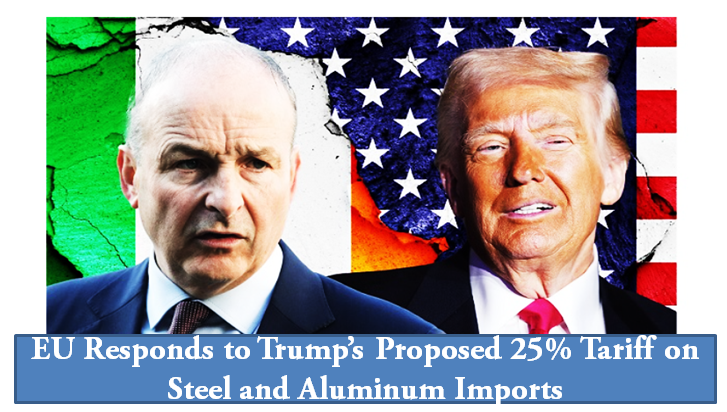
Dublin: The European Union is closely monitoring former U.S. President Donald Trump’s recent announcement to impose a 25% tariff on steel and aluminium products entering the United States. The move has sparked widespread concern across Europe, with leaders warning of potential economic repercussions, particularly for export-driven economies like Ireland.
The European Commission has clarified that it has not yet received any official notification from Washington regarding the proposed tariffs. As such, it stated that it cannot formally comment until an official communication is received. However, in a preliminary statement, the Commission strongly suggested that such tariffs would be illegal under international trade laws and warned of the economic damage they could cause to both U.S. and EU economies.
EU Commission Warns of Economic Fallout
A spokesperson for the European Commission emphasised that the EU would respond decisively to protect the interests of European businesses, workers, and consumers if the tariffs are implemented. The Commission highlighted that tariffs essentially act as taxes, which could disproportionately impact American consumers and industries by increasing costs on imported goods.
“There is no legitimate justification for imposing tariffs on European exports,” the Commission noted, warning that such measures could trigger a retaliatory trade response from the EU.
The Commission also reiterated that protectionist policies are often economically counterproductive, disrupting global supply chains and undermining the principles of free trade.
Irish Prime Minister Warns of Impact on the Economy
Taoiseach Micheál Martin expressed deep concern over the potential consequences for the Irish economy, stating that the tariffs would have a significant negative impact on Irish exports. Martin highlighted that Ireland, as a small, open economy heavily reliant on international trade, would face secondary effects even if Irish products are not directly targeted.
“Ireland thrives in a free trade environment. Tariffs not only stifle economic growth but also create uncertainty in global markets,” Martin said.
The Taoiseach confirmed that the European Commission has conducted extensive studies on the potential impact of such tariffs and that further diplomatic engagements with the U.S. government are planned to address the issue.
Concerns Over Transatlantic Relations
Martin also held discussions with European Council President António Costa and European Parliament President Roberta Metsola to coordinate the EU’s response. Their talks covered a range of critical issues, including:
- Transatlantic trade relations
- The future of EU-U.S. cooperation post-election
- EU competition policies
- The development of a new policy to return illegal immigrants to their countries of origin
- Ongoing crises in Ukraine and the Middle East
Metsola’s spokesperson confirmed that the leaders also discussed Ireland’s upcoming EU Presidency and its role in shaping future EU policies.
Irish Samachar English News
{OR} Kindly click to follow the Irish Samachar News channel on WhatsApp
Comments are closed.