
Outdated Communications Technology Blamed for Major US Air Traffic Disruption, Thousands of Flights Affected
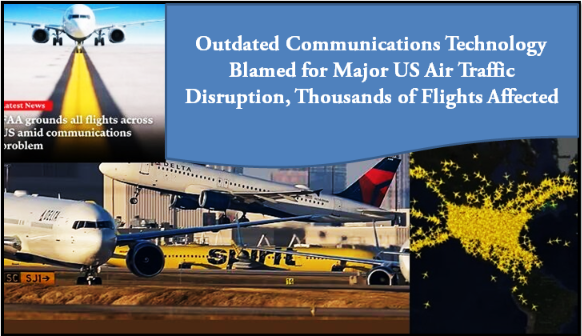
WASHINGTON: An ageing communications system dating back several decades is believed to have contributed to a major technical failure that brought large parts of the US aviation network to a standstill for several hours, according to preliminary findings.
The Federal Aviation Administration (FAA) lifted nationwide flight restrictions imposed on Friday following a disruption that lasted more than four hours. However, the impact continued into Saturday, with thousands of flights delayed, cancelled or diverted as airlines struggled to restore normal operations.
A communications failure affecting 22 air traffic control centres prompted authorities to take unprecedented precautionary measures. Disruptions to radar data and communications between aircraft and air traffic controllers led to the suspension of departures from airports across the country on safety grounds.
Outdated technology suspected as the cause
US Transportation Secretary Sean Duffy provided preliminary details about the incident during a press conference, pointing to the ageing telecommunications infrastructure supporting the country’s air traffic control network.
A significant part of the system continues to depend on analogue communications technology developed in the 1980s. Critical information is transmitted through older copper cables, switches and routers.
On Friday, routers within the network reportedly became unstable under excessive data loads, resulting in inconsistencies in information being transmitted between different air traffic control centres.
According to Duffy, the resulting disruption affected radar information and communications, creating an unacceptable safety risk.
Although the communications network did not fail completely, some information became intermittently unavailable, raising concerns about the reliability of the data available to air traffic controllers.
More than 3,500 aircraft in the sky when disruption struck
The widespread technical instability was detected at approximately 3.36pm on Friday, US time, when more than 3,500 aircraft were flying across American airspace.
Authorities immediately stopped new departures while prioritising the safe landing of aircraft already in the air. Flights were directed towards their intended destinations or suitable alternative airports, depending on operational requirements.
Pilots and air traffic controllers followed established emergency safety procedures to manage the situation. Officials said they gradually reduced the number of aircraft in the sky to fewer than 400 before the restrictions were lifted.
How was the problem resolved?
FAA technicians examined the affected communications network and introduced corrective measures to reduce the excessive data load.
The response included reconfiguring parts of the system and restarting equipment to restore normal operations. Following the technical work, safety checks were carried out at air traffic control centres and Terminal Radar Approach Control (TRACON) facilities, which manage aircraft movements in the vicinity of airports.
The nationwide flight restrictions were lifted at approximately 8.15pm Eastern Time on Friday.
However, the restoration of services does not necessarily mean that the underlying technical problem has been permanently resolved. Officials have warned that similar failures could occur again while the ageing infrastructure remains in operation. An investigation into the root cause is continuing.
Cyberattack suspected, but officials find no evidence
The widespread disruption to American air travel prompted speculation about a possible cyberattack, particularly given the scale of the communications failure.
However, Homeland Security Secretary Markwayne Mullin said there was no evidence indicating that the incident was caused by a cyberattack.
Officials also ruled out a direct connection with the separate technical disruption affecting Microsoft’s services.
Investigators examined whether the newly introduced artificial intelligence system for air traffic control could have contributed to the failure. However, no evidence has emerged linking the AI system to the incident. The Department of Transportation said the newly installed equipment had not malfunctioned.
A final technical assessment has yet to establish whether any interaction between the legacy communications infrastructure and newer technology being introduced as part of the modernisation programme played a role.
National security agencies join the investigation
The FAA was supported by several federal agencies during the emergency response and investigation, reflecting the importance of maintaining the safety and reliability of the country’s aviation infrastructure.
The National Security Agency, Department of Defense, Cybersecurity and Infrastructure Security Agency, and Federal Emergency Management Agency were among the organisations involved.
President Donald Trump was also briefed on the situation.
Officials said the emergency restrictions were imposed as a precaution to prevent a technical malfunction from developing into a more serious aviation safety or national security incident.
Thousands of flights cancelled as passengers face disruption
The scale of the disruption was reflected in flight statistics, with approximately 10,000 flights delayed and around 5,000 cancelled across the United States, according to figures reported at different stages of the crisis.
Hundreds of aircraft were also diverted or returned to their departure airports.
Major aviation hubs, including Chicago, Atlanta, Dallas, Los Angeles and New York, experienced widespread disruption.
Although the FAA lifted the restrictions, airlines warned that restoring normal services would take time. Aircraft and flight crews had been left in locations different from those scheduled, creating further operational challenges.
United Airlines and Delta Air Lines gradually resumed services, while some carriers cancelled the remainder of their scheduled flights on Friday night.
Dublin-US flights also affected
The disruption also affected transatlantic air services between Ireland and the United States, raising concerns among passengers travelling through Dublin Airport.
Although Aer Lingus flights travelling towards the United States were permitted to land, services departing from American airports were affected by the nationwide restrictions.
Dublin Airport warned passengers of possible delays to flights on Saturday morning. Despite the lifting of restrictions in the United States, further disruption to Dublin-US services remained possible as airlines worked to reorganise aircraft schedules and crew arrangements.
US air traffic system needs an additional $50 billion
The crisis has renewed scrutiny of the ageing infrastructure supporting one of the world’s busiest aviation networks.
Transportation Secretary Sean Duffy has called for an additional $50 billion to fund a comprehensive modernisation programme, arguing that the $12.5 billion previously allocated would not be sufficient to complete the necessary upgrades.
The proposed improvements include replacing outdated copper cables with modern fibre-optic systems and completely overhauling the communications infrastructure used by air traffic controllers.
The latest incident is not the first time a technical failure has disrupted US aviation. In January 2023, a computer system failure at the FAA forced flights across the country to be temporarily grounded. Nationwide flight restrictions were also imposed following the terrorist attacks of September 11, 2001.
The latest crisis has exposed the vulnerability of an aviation system that, despite operating in one of the world’s most technologically advanced countries, still relies on critical infrastructure developed decades ago. Although flights have resumed, questions remain about the reliability of the US air traffic control network and the urgency of replacing its ageing technology.
Irish Samachar English News