
Ireland Assumes EU Council Presidency for Eighth Time, Taking Centre Stage in European Decision-Making
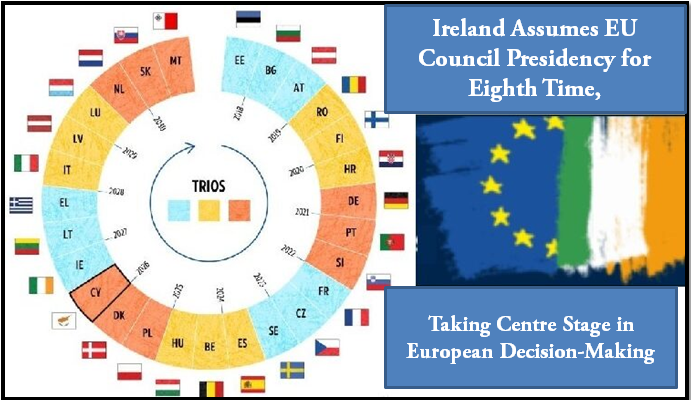
Brussels: Ireland is set to assume the Presidency of the Council of the European Union on July 1, 2026, marking the eighth time the country has held the influential position since joining the European Economic Community in 1973.
The six-month presidency is regarded as one of the most significant diplomatic responsibilities undertaken by Ireland in recent years. It provides an opportunity for the country to demonstrate its leadership within the European Union, strengthen its influence on key policy issues, and showcase Irish culture, innovation and expertise on the European stage.
Ireland will hold the rotating presidency until December 31, placing it at the centre of European Union decision-making during a period of major political, economic and security challenges.
A Key Role in EU Governance
As President of the Council of the European Union, Ireland will coordinate the work of EU member states and oversee negotiations on a wide range of legislative and policy initiatives.
The presidency requires Ireland to chair hundreds of meetings involving ministers, diplomats and senior officials from across the bloc. In this role, Ireland will act as an impartial broker, helping member states build consensus and advance agreements on complex European issues.
Key areas expected to dominate the agenda include European competitiveness, economic growth, support for Ukraine, migration policy, energy security, digital transformation, climate action and negotiations on the EU’s long-term budget.
Ireland’s Largest Diplomatic Mission in Recent Years
The presidency is widely regarded as the largest diplomatic undertaking in Ireland’s recent history. Preparations have been underway for months across government departments to ensure the smooth delivery of the extensive programme of events and meetings.
Over the six-month term, Ireland will host numerous high-level conferences, ministerial meetings and international delegations. Thousands of EU officials, government representatives and policy experts are expected to travel to Ireland to participate in discussions on the future direction of the European Union.
The scale of the presidency has required significant planning in areas such as logistics, security, transport and event management.
Focus on Security and International Cooperation
Security and operational planning will be major priorities throughout the presidency period. Hundreds of official events are expected to take place across the country, elevating Ireland’s international profile and placing it at the heart of European policymaking.
As Council President, Ireland’s primary responsibility will be to facilitate dialogue and help member states reach common positions on some of the EU’s most sensitive and challenging issues.
Government officials have described the presidency as a unique opportunity to strengthen Ireland’s standing within Europe while contributing to the advancement of the European Union’s strategic priorities during a critical period for the bloc.
Irish Samachar English News
Comments are closed.