
Ireland Prepares for Tenth Presidential Election on October 24
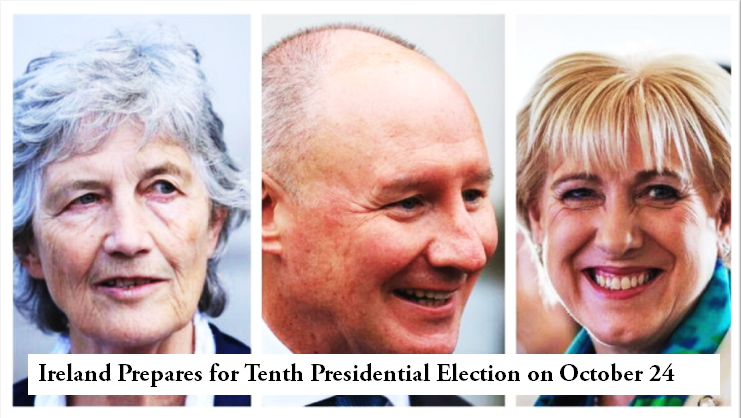
Dublin: Ireland’s tenth presidential election will take place on Friday, October 24, with just three candidates in the running—the smallest list since 1990.
The candidates are:
- Catherine Connolly, Independent TD, supported by People Before Profit–Solidarity along with the Social Democrats, Labour, the Green Party and Sinn Féin.
- Heather Humphreys of Fine Gael.
- Jim Gavin of Fianna Fáil.
Nomination Process
To secure a nomination, candidates must either receive the backing of 20 Oireachtas members (TDs or Senators) or obtain the support of four local authorities. An incumbent president may nominate themselves for a second seven-year term, but the Constitution limits any president to a maximum of two terms.
A Look Back at Former Presidents
Ireland’s first president, Douglas Hyde, took office in June 1938. Since then, the role has been held by Seán T. O’Kelly (1945–1959), Éamon de Valera (1959–1973), Erskine Childers (1973–1974), Cearbhall Ó Dálaigh (1974–1976), Patrick Hillery (1976–1990), Mary Robinson (1990–1997), Mary McAleese (1997–2011), and current president Michael D. Higgins, whose 14-year tenure ends this November.
Campaign Finance Rules
Under the Electoral Act 1997, candidates may spend up to €750,000 on their campaigns. Those elected or receiving more than 25% of the vote are eligible for reimbursement of up to €200,000.
All donations above €600 must be declared to the Standards in Public Office Commission (SIPO). Limits apply:
- €1,000 maximum from an individual or corporate donor.
- €200 maximum from unregistered corporate donors.
- No anonymous donations above €100 are permitted.
Candidates must also maintain a political donation account.
Voter Eligibility and Registration
All Irish citizens aged 18 or over and ordinarily resident in the State may vote. The deadline for voter registration is Tuesday, October 7, with an estimated 60,000 new voters to be added to the electoral roll.
Voting is primarily in person at official polling stations, but postal voting is available under specific circumstances, including for:
- Members of An Garda Síochána and the Defence Forces.
- Diplomats and their spouses abroad.
- Those unable to attend due to illness, disability, employment, or study.
- Voters requiring anonymity for security reasons.
The deadline for postal voting applications is Monday, September 29.
Voting and Counting
Polling will take place by secret ballot on October 24, from 7 a.m. to 10 p.m., under the single transferable vote system (PR-STV). Voters may rank candidates by preference.
Counting begins at 9 a.m. on Saturday, October 25. If no candidate secures the required quota (50% + 1 of valid votes), the lowest-ranked candidate is eliminated and their votes redistributed until a winner emerges. Results are expected late Saturday or by Sunday.
Presidential Inauguration
The inauguration traditionally takes place in St. Patrick’s Hall, Dublin Castle, the day after results are confirmed. The Taoiseach formally welcomes the president-elect, who is then sworn in by the Chief Justice—currently Donal O’Donnell. The ceremony includes the Army No. 1 Band playing the national anthem, after which the new president proceeds to Áras an Uachtaráin.
Role and Powers of the President
The president serves as Head of State, representing Ireland at home and abroad. While largely a ceremonial figure, the president has important constitutional powers, including:
- Signing bills into law (or referring them to the Supreme Court for review).
- Appointing the Taoiseach and Cabinet ministers on the Dáil’s nomination.
- Serving as Supreme Commander of the Defence Forces.
- Delivering national addresses on matters of public importance.
Irish Samachar English News
Comments are closed.