
The opposition has strongly criticised the government’s latest budget
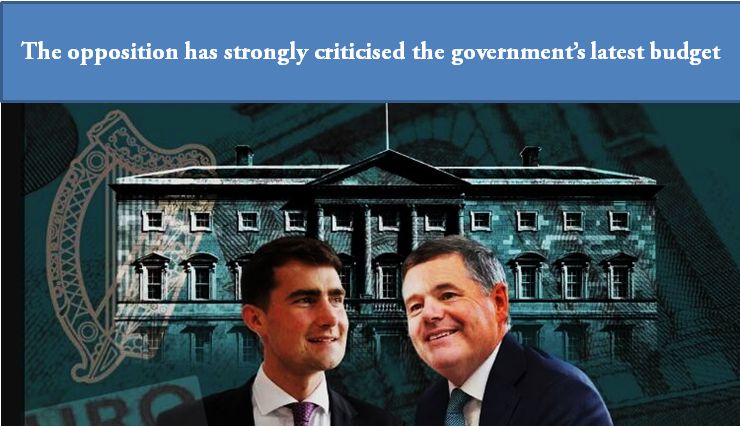
Dublin: The opposition has strongly criticised the government’s latest budget, accusing it of neglecting the pressing social and economic challenges facing ordinary citizens. Sinn Féin, the Labour Party, and the Social Democrats said the budget disproportionately benefits developers and large corporations instead of workers and struggling families.
Sinn Féin: “A Budget That Abandons Ordinary People”
Sinn Féin’s finance spokesperson, Piers Doherty, said the budget had “completely abandoned ordinary people” at a time when the cost-of-living crisis continues to deepen. He accused the government of granting generous tax breaks to the wealthy and developers while ignoring the financial hardship faced by families earning between €30,000 and €40,000 annually.
“Developers and landlords are receiving tax breaks worth hundreds of thousands of euros, while ordinary workers get nothing,” Doherty said. “This was supposed to be a cost-of-living budget—instead, it’s a developer’s charter.”
Social Democrats: “A Budget of Bad Choices and Missed Opportunities”
Social Democrats’ finance spokesperson Cian O’Callaghan said the government had failed to seize the opportunity to lift thousands of children out of poverty.
“The government has chosen to prioritise big developers and fast-food giants over struggling families,” he said. “It’s a budget of bad choices and missed opportunities.”
O’Callaghan noted that the government reduced tax collection by €1.3 billion, forfeiting funds that could have supported vulnerable groups. He argued that measures such as expanding Child Benefit, abolishing the carers’ means test, cutting third-level fees, and reducing childcare costs could have helped 40,000 children escape poverty.
“Instead,” he said, “the government has cut VAT for multinationals like McDonald’s and Starbucks, both of which are already making huge profits.”
Labour: “A Budget for Developers, Not the People”
Labour’s housing spokesperson Connor Sheehan called it the “Galway Tent Budget”—a reference to the party’s claim that the government is serving the interests of developers and elites.
He said the decision to provide €390 million per year in VAT relief for apartment construction, without any conditions, would push the total developer tax package to €563 million annually when combined with other tax deductions.
“Developers will now earn an additional 4% profit per apartment on top of existing margins of 15–20%. Meanwhile, 220,000 children live in poverty, and more than 5,100 children are homeless,” Sheehan said.
“There are no new measures to address homelessness or corruption in the sector.”
Fuel Prices Set to Rise: 2.5 Cent Increase Per Litre
With the carbon tax hike included in the budget, the price of petrol and diesel will rise by 2.5 cents per litre, effective immediately. The government also confirmed that electricity credits will not continue next year, a move widely condemned by opposition parties and social organisations.
Finance Minister Pascal Donohoe defended the decision, saying one-off cost-of-living supports had served their purpose but that targeted aid for the most vulnerable would continue.
Rising Energy Costs and Carbon Tax Increases
Electricity prices have risen 69% since 2021, while gas prices have more than doubled (102%). Average household electricity bills are expected to climb to €1,900 this year, up from €1,200 in 2021.
The carbon tax, introduced in 2020 and scheduled to rise annually until it reaches €100 per tonne by 2030, will add further pressure. The increase will apply to all carbon-based fuels, including coal, gas, heating oil, and briquettes, from May 1 next year.
The government expects the higher tax to generate €121 million in 2026, rising to €157 million in a full year.
Criticism Over Ending Energy Credits
Sinn Féin’s Piers Doherty called the decision to end household energy credits “shameful”. Family Carers Ireland said it would have a “severe impact” on vulnerable families.
Between April 2022 and February 2025, Irish households received nine energy credits totalling €1,500, costing the state €3 billion.
Fuels for Ireland CEO Kevin McPartlan accused the government of “breaking its promise” to lower energy costs. He warned that planned changes to the renewable transport fuel levy would add 2–3 cents per litre from January 2026, further driving up prices.
Targeted Benefits for the Most Vulnerable
The fuel allowance for those over 66 and families receiving the Working Family Payment will rise from €33 to €38 per week from January, covering the period from September to April.
The household benefits package of €35 per month for pensioners and certain welfare recipients will also be maintained.
The reduced 9% VAT rate on gas and electricity bills will remain in place for the next five years, a move welcomed by charities including Irish Rural Link.
Meanwhile, the diesel rebate scheme for hauliers will continue, and accelerated capital allowances for energy-efficient equipment and gas vehicles have been extended until 2030. The €5,000 VRT relief for electric vehicles will also remain in place until 31 December 2026.
Irish Samachar English News
Comments are closed.