
European Leaders Unite in Dublin to Demand a Stronger Role in Ukraine Peace Talks
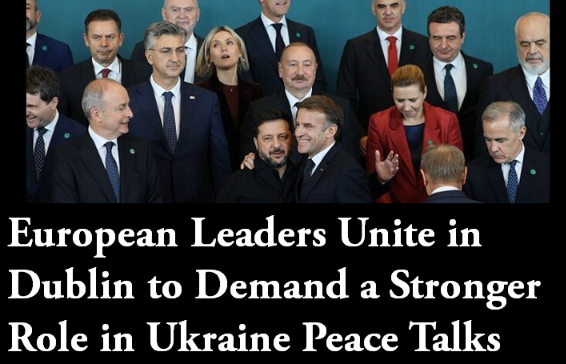
DUBLIN: As diplomatic efforts to end the Russia-Ukraine war reach a critical stage, European leaders have gathered in Dublin to reaffirm their unwavering support for Ukraine and insist that Europe must have a decisive voice in negotiations over the country’s future.
The European Political Community (EPC) summit sent a clear message that neither the United States nor Russia should be allowed to dominate negotiations that will shape not only the outcome of the war but also Europe’s long-term security and political future.
The discussions, attended by Ukrainian President Volodymyr Zelensky, French President Emmanuel Macron, German Chancellor Friedrich Merz and other European leaders, reflected a growing determination across the continent to adopt a stronger and more coordinated approach towards Russia.
Why is Ukraine so important to Europe?
Although Ukraine is not yet a member of the European Union, it occupies a strategically important position in European security. Sharing a lengthy border with Russia, the country lies between the EU and Russia, making its sovereignty and territorial integrity central to the continent’s stability.
European leaders believe that allowing Ukraine’s sovereignty and internationally recognised borders to be undermined could create a wider security threat for other countries. Russia’s military actions remain a particular concern for neighbouring states such as Poland and the Baltic countries.
For European governments, supporting Ukraine is therefore about more than defending an individual country. It is also about upholding a fundamental principle of international law: national borders cannot be changed through military force.
However, concerns remain over whether Europe’s increasingly firm position could further intensify tensions with Moscow.
Is Europe preparing for a war with Russia?
The Dublin summit produced no decision to pursue direct military confrontation with Russia. However, European countries have signalled their readiness to strengthen economic sanctions, maintain defence assistance to Ukraine and improve their own military capabilities.
Zelensky called for tougher restrictions on Russian oil tankers, banks and financial institutions suspected of supporting Russia’s weapons production. He maintained that a lasting peace would be impossible without strengthening Ukraine’s ability to defend itself.
Macron, meanwhile, warned that Europe must urgently reinforce its own defence capabilities. His assessment that Ukraine was no longer receiving the same level of support from the United States as it had previously received highlighted growing concerns about Europe’s dependence on American security assistance.
Underlying these statements is an increasingly shared view among European leaders that the continent must take greater responsibility for its own defence rather than rely exclusively on the United States.
Europe must not be excluded from peace negotiations
The demand for direct European participation in peace negotiations between the United States and Russia received strong support at the Dublin summit.
US envoys Steve Witkoff and Jared Kushner also met Zelensky in Dublin. The Ukrainian president subsequently reported progress on several issues, including arrangements for the exchange of prisoners of war.
However, no final decision has been reached on how Europe will be represented in the negotiations. Irish Taoiseach Micheál Martin suggested that a group comprising several European leaders could be appointed to represent the continent’s interests.
Zelensky also renewed his call for Ukraine’s progress towards EU membership to be accelerated. Beyond security considerations, Ukraine’s economic relationship with Europe, along with cooperation in energy and transport, further strengthens its strategic importance to the continent.
Potential for drone cooperation between Ireland and Ukraine
Ireland is also examining opportunities to cooperate with Ukraine in developing and producing advanced drone technology.
Discussions have included the possibility of purchasing Ukrainian drone systems and receiving training and technical expertise. However, no formal agreement has yet been finalised.
Such cooperation could be significant for Ireland, given its longstanding policy of military neutrality and its interest in strengthening its defence and security capabilities.
The positions expressed at the Dublin summit suggest that Europe’s growing military and economic preparedness is primarily intended to deter potential threats from Russia and strengthen its negotiating position, rather than prepare for an attack on Moscow.
Russia, meanwhile, continues to argue that Western policies, particularly NATO’s eastward expansion and what it describes as the disregard of its security concerns, have contributed to the conflict. European countries reject this justification, maintaining that such concerns cannot legitimise Russia’s military invasion of Ukraine.
The central message emerging from Dublin was that the outcome of negotiations over Ukraine will have consequences far beyond its borders. The decisions taken by European leaders on how to confront Russia, support Ukraine and pursue a lasting peace will play a defining role in shaping the continent’s future security and stability.
Irish Samachar English News