
US Midterm Elections: Democrats Take Control of Congress, Delivering Major Blow to Trump’s Final Two Years
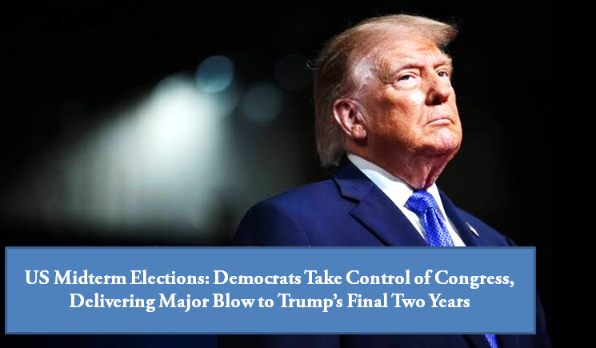
Washington: Democrats have reportedly secured control of both the US House of Representatives and the Senate in the midterm elections, delivering a significant political setback to President Donald Trump and threatening to complicate his legislative agenda during the final two years of his term.
The Democratic gains, extending into traditionally Republican strongholds, could force the White House to negotiate with the opposition on a wide range of issues, from legislation and government spending to senior appointments and foreign policy.
According to provisional results available on November 5, Democrats have secured 54 seats in the 100-member Senate, compared with 44 for Republicans. The outcomes in Alaska and Mississippi have yet to be declared. Although Democrats are also reported to have won a majority in the House of Representatives, the final distribution of seats remains subject to confirmation.
The figures are based on media projections and declarations of victory, with the official counting and certification process still under way.
Democrats reportedly captured seven Senate seats previously held by Republicans, in Texas, Kansas, Iowa, Ohio, Maine, North Carolina and South Carolina. The results suggest that dissatisfaction with the administration has extended beyond the traditional battleground states.
The reported Democratic victory in Kansas is particularly significant, marking the party’s return to a Senate seat after nearly a century. Victories by James Talarico in Texas, Sherrod Brown in Ohio and Troy Jackson in Maine have also been presented as evidence of the scale of the Democratic advance. Jon Ossoff retained his seat in Georgia.
Vance blames Iran war for Republican setback
US Vice-President JD Vance has attributed much of the Republican defeat to the war involving Iran.
In a statement on X, Vance argued that the setback was not primarily the result of Republican supporters staying away from polling stations. Instead, he suggested that some voters who had supported the Trump-Vance ticket in 2024 had switched their allegiance to Democrats.
According to Vance, many dissatisfied voters wanted an end to the war, relief from the rising cost of living, a stronger focus on American interests and a reassessment of the country’s relationship with Israel.
However, the election result appears to reflect broader dissatisfaction rather than opposition to the war alone.
An Associated Press survey of more than 100,000 voters reportedly found that six in 10 considered US military action against Iran the wrong decision. Around one-third identified the war as the most important factor influencing their vote, while approximately half pointed to the cost of living and government corruption as major concerns.
The findings suggest that anti-war sentiment, economic pressures and declining confidence in the administration may have combined to drive the Democratic gains.
Trump has acknowledged that the war affected the election but has continued to defend the military action, maintaining that it was necessary and should continue. He has also said he understands Vance’s assessment. Their differing remarks do not necessarily indicate an immediate political split within the administration.
Trump faces a more powerful opposition in Congress
The election result does not bring Trump’s presidency to an end. However, it significantly changes the political balance in Washington, removing the support of a favourable congressional majority.
With the new Congress preparing to take office, Democrats are expected to intensify investigations into the administration, strengthen congressional oversight and pursue an ambitious programme during their first 100 days.
One of the most important areas of potential conflict will be presidential appointments.
Nominations to the Supreme Court, other federal courts, senior Cabinet positions and diplomatic posts require Senate approval. A Senate controlled by Democrats could delay or reject controversial nominees, subjecting the President’s choices to greater scrutiny.
Consequently, even if a vacancy arises on the Supreme Court during the remainder of Trump’s term, securing confirmation of his preferred candidate could prove difficult.
Iran war likely to face greater congressional scrutiny
The administration’s military policy towards Iran is also likely to come under increased pressure.
Democrats could demand greater transparency over the cost, objectives and long-term consequences of military operations. Congress has significant influence over military policy through its control of government funding and its oversight responsibilities.
The party may seek restrictions on military spending or challenge the administration’s use of executive authority. However, a Democratic victory in the midterms does not automatically mean that the war will end.
The issue is likely to become a major point of confrontation between the White House and the newly empowered opposition.
Impeachment debate could return
The possibility of impeachment may also re-emerge as Democrats gain control of the House.
However, initiating impeachment proceedings and removing a president from office are two separate constitutional processes.
The House of Representatives has the authority to approve articles of impeachment, but conviction and removal require the support of two-thirds of senators present during the trial. If all 100 senators participate, at least 67 votes would be necessary.
Democrats therefore cannot remove Trump through their Senate majority alone. They would need substantial support from Republican senators as well.
Democrats face pressure to deliver on domestic priorities
Despite their electoral gains, Democrats will face considerable challenges in translating public dissatisfaction into practical policy changes.
Their priorities are expected to include restoring tax credits under the Affordable Care Act, reversing Medicaid cuts, challenging Trump’s approach to the Iran war and reviewing his tariff policies.
The cost of living is likely to remain a central concern for voters. While investigations and oversight may dominate the early stages of the new Congress, Democrats will also face pressure to demonstrate that their electoral victory can produce tangible improvements in people’s lives.
Even if legislation passes both chambers, Trump retains the power to veto bills. Overriding a presidential veto requires a two-thirds majority in both the House and the Senate.
The Democratic victory therefore does not guarantee that all the party’s proposals will become law. Negotiations, compromises and potentially prolonged political confrontations are likely to shape the legislative agenda.
Republican divisions could influence the 2028 presidential race
The results could also intensify internal debates within the Republican Party ahead of the 2028 presidential election.
Vance’s criticism of the administration’s approach to the Iran war may be interpreted as an attempt to distance himself from some of Trump’s less popular decisions. However, as Vice-President, he remains closely associated with the administration and cannot entirely separate himself from its record.
That tension could become an important challenge if he seeks the Republican presidential nomination in 2028.
Vance’s reported remark, “We’ll lose the Senate for the next six years,” should also be understood as a political assessment rather than a certainty. US senators serve six-year terms, but approximately one-third of Senate seats are contested every two years. The balance of power could therefore change in the 2028 and 2030 elections.
A Democratic majority today does not guarantee uninterrupted control of the Senate for the next six years.
With Trump continuing to occupy the White House but facing an opposition-controlled Congress, the political landscape in Washington is set for a more confrontational period.
Irish Samachar English News