
Migrant Organisations Protest Proposed Tougher Irish Citizenship Rules, Opposing Eight-Year Residency Requirement
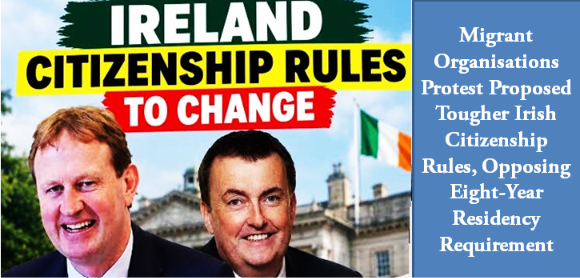
Dublin: A coalition of migrant and human rights organisations is protesting against proposed changes to Ireland’s citizenship laws, including plans to extend the qualifying residency period from five to eight years and introduce language and income requirements for applicants.
Around a dozen organisations, several of which receive Government funding, are expected to take part in a demonstration outside Leinster House on Tuesday. The protest comes as the Government prepares legislative measures aimed at tightening the requirements for obtaining Irish citizenship through naturalisation.
‘Keep Citizenship Fair’ campaign
Twelve organisations have joined forces under the banner Keep Citizenship Fair to oppose the proposed changes. The demonstration is taking place near the Kildare Street entrance to Leinster House.
The participating groups include the Migrant Rights Centre Ireland, the Irish Refugee Council, Doras, the Immigrant Council of Ireland, NASC, AkiDwA, the Hope and Courage Collective, the Irish Network Against Racism, Open Doors, the Culture Migrants Centre and the Africa Centre.
The Irish Council for Civil Liberties is also mentioned in connection with the campaign, although the original information about the participating organisations and their Government funding status requires clarification.
Government plans stricter citizenship requirements
The proposed changes could extend the mandatory residency period for naturalisation from five to eight years. Other measures under consideration include a language proficiency test and a minimum income threshold.
The Government says the proposals are intended to strengthen the naturalisation process and encourage the social integration of migrants.
Tánaiste Simon Harris has also defended the need for stricter eligibility criteria, arguing that the standards for obtaining Irish citizenship should remain high. He has said citizenship is not simply a right but also a recognition that carries important responsibilities.
Organisations warn migrant workers could be affected
Neil Bruton, director of the Migrant Rights Centre Ireland, has warned that the proposed changes could disproportionately affect migrant workers, particularly those on lower incomes.
He criticised the proposed extension of the residency requirement and expressed concern that income conditions and restrictions linked to social welfare payments could prevent people from qualifying for citizenship despite having established their lives in Ireland.
Bruton said the measures risk making naturalisation significantly more difficult for thousands of people who have contributed to Irish society through their work and communities.
Describing the proposals as unfair, he called on migrants, their families, friends and colleagues to join the demonstration outside Leinster House and make their opposition clear to politicians.
Sinn Féin and Labour favour stricter integration measures
Sinn Féin, the main opposition party, has also called for stronger social integration requirements for people seeking Irish citizenship.
Matt Carthy, the party’s spokesperson on justice and immigration and TD for Cavan–Monaghan, has argued that applicants should demonstrate a genuine commitment to Irish society.
He has suggested introducing a citizenship test to assess applicants’ knowledge of Ireland, while also proposing recognition for those who demonstrate proficiency in the Irish language.
Carthy has further emphasised that applicants should comply with immigration rules, meet their tax obligations, respect Irish law and have no serious criminal record, whether in Ireland or abroad.
The Labour Party has expressed similar support for stronger citizenship requirements. Its manifesto for the 2024 general election included proposals for mandatory language and citizenship tests.
Other opposition parties have also called for applicants to demonstrate language proficiency and a general understanding of Ireland as part of the naturalisation process.
Irish Samachar English News