
Dublin Emerges as Centre of Global Diplomacy as European Leaders Discuss Security, Trade and AI
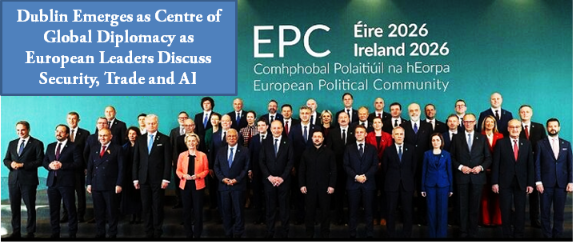
DUBLIN: The Irish capital has emerged as a centre of international diplomacy, hosting high-level discussions on issues expected to shape Europe’s political, economic and technological future. The European Political Community (EPC) Summit brought together leaders from more than 40 countries, with changing relations with the United States, security concerns over Russia, economic competitiveness, artificial intelligence and energy security dominating the agenda.
The ninth European Political Community Summit, held at the Convention Centre Dublin on Thursday, November 12, was among the largest gatherings of international political leaders hosted by Ireland.
Those attending included Irish Taoiseach Micheál Martin, French President Emmanuel Macron, German Chancellor Friedrich Merz, British Prime Minister Andy Burnham, Canadian Prime Minister Mark Carney and Ukrainian President Volodymyr Zelensky.
The presence of leaders from countries including the United Kingdom, Norway, Switzerland, Turkey and Canada, alongside representatives of European Union member states, further underlined the international significance of the gathering.
What were the main issues discussed?
Leaders expressed broad agreement on the need to maintain support for Ukraine, strengthen Europe’s resilience, improve cooperation against cyberattacks and other hybrid threats, increase investment in emerging technologies and ensure access to affordable, clean energy.
However, the European Political Community is not a legally binding decision-making institution. Consequently, the declarations and commitments made at the summit do not automatically constitute formal agreements. Their practical impact will depend on the follow-up measures taken by participating governments.
Britain seeks closer ties with Europe after Brexit
The participation of British Prime Minister Andy Burnham was particularly significant, highlighting renewed efforts to strengthen relations between the United Kingdom and European countries following Brexit.
Britain is seeking closer cooperation with Europe in areas including security, trade and diplomacy. The discussions in Dublin therefore provided an important opportunity to explore ways of rebuilding and deepening those relationships.
Canada looks to strengthen European ties amid Trump’s trade policies
Canada is also seeking to expand its relationship with Europe amid uncertainty surrounding US President Donald Trump’s trade policies.
The attendance of Canadian Prime Minister Mark Carney highlighted Ottawa’s interest in developing closer economic and political links with the European Union. Discussions explored the potential for a deeper partnership, including opportunities to strengthen trade and cooperation.
The broader idea of diversifying international trade relationships and reducing excessive dependence on the United States is gaining traction on both sides of the Atlantic.
Dublin under tight security as 5,000 Gardaí are deployed
Dublin witnessed extensive security arrangements ahead of the arrival of international leaders, with approximately 5,000 Gardaí deployed across the city.
Traffic restrictions and additional security measures were introduced around the Convention Centre and other key locations to facilitate the high-level meetings and protect visiting delegations.
The summit was preceded by a series of hoax bomb threats targeting schools, media organisations and airlines. Although those responsible had not been identified, the incidents highlighted the growing importance of international cooperation in tackling cybercrime and hybrid security threats. These concerns also featured prominently in the wider discussions.
EU leaders meet again as artificial intelligence takes centre stage
Following Thursday’s EPC summit, leaders of the European Union’s 27 member states are gathering in Dublin on Friday, November 13, for an informal meeting.
The summit is particularly significant because artificial intelligence has emerged as a central strategic issue for European leaders. One of the key questions is how Europe can remain competitive with the United States and China in the rapidly developing AI sector.
Discussions are expected to cover the impact of artificial intelligence on employment and industry, children’s online safety, personal privacy and investment in emerging technologies.
Arthur Mensch, chief executive of Mistral AI, and Nobel Prize-winning AI researcher Geoffrey Hinton are also scheduled to take part in the discussions. The outcomes and any decisions arising from the meeting are yet to be announced.
What does Ireland stand to gain?
Hosting the Dublin summits represents a significant diplomatic opportunity for Ireland. The gatherings have brought major European powers and international partners outside the EU together on a common platform, allowing Ireland to strengthen its international profile and diplomatic influence.
The meetings are also expected to create opportunities for new partnerships in areas such as technology, defence cooperation, clean energy and financial investment.
The diplomatic programme was further strengthened by an official banquet for visiting leaders at the National Gallery of Ireland, alongside a series of bilateral meetings.
As Europe faces mounting challenges from war, trade disputes and intensifying technological competition, Dublin has become the setting for discussions about the continent’s future direction.
The central question now is whether these discussions will translate into concrete action and help Europe emerge as a more independent and influential power in the fields of economics, defence and technology.
Irish Samachar English News