
Israel Election Deadlock: Netanyahu Leads but Falls Short of Majority as Arab Parties Hold Key to Government Formation
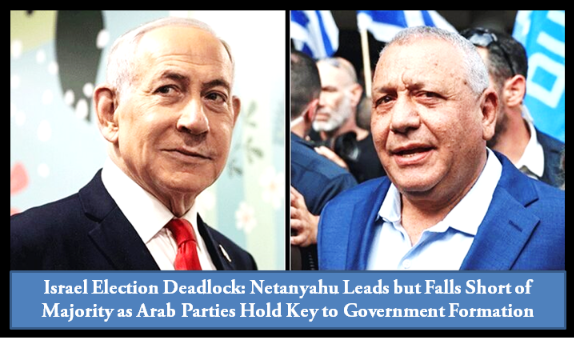
Jerusalem: Uncertainty continues to surround Israel’s election results, with Benjamin Netanyahu’s Likud emerging as the largest party but neither major political bloc securing enough seats to form a government independently.
According to the provisional count available on the morning of October 29, Netanyahu’s right-wing and religious bloc is projected to win 53 seats, while the opposition bloc led by Gadi Eisenkot is expected to secure 48. The two Arab-led political groupings are projected to win a combined 19 seats. A majority of 61 is required in the 120-member Knesset.
Although around 91 per cent of the votes had reportedly been counted, the final results had not been announced. The counting of special “double-envelope” ballots, including votes cast by soldiers, diplomats, hospital patients and others, could still affect the distribution of seats.
The figures leave Netanyahu’s political future uncertain. Despite Likud’s position as the largest party, his continued leadership is far from guaranteed.
Arab parties’ seat allocation remains uncertain
The widely reported provisional tally gives Likud 26 seats, followed by Eisenkot’s Yashar party with 21. The B’Yachad list, associated with Naftali Bennett and Yair Lapid, is projected to win 12 seats, while Yair Golan’s Democrats are expected to secure eight. Avigdor Lieberman’s Yisrael Beiteinu is projected to win seven seats.
Among Netanyahu’s allies, Shas, United Torah Judaism and Otzma Yehudit are each projected to receive seven seats, while the joint Religious Zionism–Zehut list is expected to secure six.
The Arab-led Joint List initially appeared set to win 12 seats, with Mansour Abbas’s Ra’am projected to receive seven. However, several media outlets reported on Thursday morning that Ra’am had gained an additional seat at the Joint List’s expense, putting the two parties at 11 and eight seats respectively.
The Times of Israel reported that this change had not yet been reflected in the Central Elections Committee’s figures available at 5.57 a.m. The combined projected total for the two parties remained 19 seats.
Who can help Netanyahu form a government?
Netanyahu’s traditional allies include the far-right parties led by Itamar Ben-Gvir and Bezalel Smotrich, alongside the religious parties Shas and United Torah Judaism. Even if all these parties remain aligned with him, the projected total of 53 seats would leave the bloc eight short of a majority.
Netanyahu would therefore need additional parliamentary support or a new political arrangement to reach the required 61 seats.
Possible scenarios include a unity government involving some opposition parties, support from lawmakers outside his existing bloc, or an agreement with one or more Arab-led parties. However, no such arrangement has been confirmed.
For opposition leaders who campaigned on removing Netanyahu from power, supporting a government that includes him would be politically difficult to explain to their voters. Conversely, forming an alternative government would require parties with sharply differing views to overcome their disagreements.
If negotiations fail, Israel could face another election. In that event, Netanyahu would remain in office as head of a caretaker government until a new administration was formed.
Why Ra’am’s possible eighth seat matters
If Ra’am secures eight seats, its support could bring Netanyahu’s projected 53-seat bloc to the 61-seat threshold. However, the arithmetic alone does not establish that the party would support him or that a coalition agreement would be politically feasible.
Such an arrangement would present a major contradiction for Netanyahu and his far-right allies, who have repeatedly opposed cooperation with Arab political parties.
Ra’am leader Mansour Abbas has reportedly said that Likud approached his party. He has also indicated a willingness to consider supporting an alternative government led by Eisenkot. The party’s eventual position could therefore prove important to both sides.
Opposition unity faces major challenges
Israel’s opposition is not a unified political movement. It brings together right-wing nationalists, centrists and left-wing parties whose positions differ significantly on the Palestinian question, military policy towards Hamas, the political participation of Arab citizens and relations between religious and secular communities.
A major obstacle is the reluctance of Eisenkot, Bennett and Lieberman to rely on Arab-party support to form a government. Golan, by contrast, has called for greater political cooperation with Arab citizens and their representatives.
These differences complicate efforts to build an alternative coalition. Opposition to Netanyahu does not necessarily mean agreement on the Palestinian state, security policy or the role of Arab parties in government.
The political challenge is therefore not simply whether the opposition has enough seats on paper, but whether its leaders can reach an agreement that satisfies their competing priorities.
What do the Arab parties want?
The immediate priority of the Arab-led parties is to replace Netanyahu’s government, but they differ over how they would support an alternative administration.
Ra’am has expressed greater openness to direct participation in a government, while the Joint List has indicated that it could support an alternative administration from outside the coalition.
Their demands are expected to focus on issues affecting Arab communities, including organised crime, housing shortages, discrimination and inadequate public investment.
With 48 seats projected for Eisenkot’s opposition bloc and 19 for the Arab-led parties, their combined total would be 67 — enough for a parliamentary majority if they could agree to cooperate.
However, if the opposition secured support only from Ra’am, with either seven or eight seats, its total would reach just 55 or 56. It would still need the support of the Joint List or additional lawmakers to form a government.
Despite the potential numbers, political divisions and longstanding mistrust could make an agreement difficult to achieve.
Herzog urges parties to avoid another election
Once the final results are confirmed, President Isaac Herzog is expected to consult political parties before deciding whom to invite to form the next government. Under Israel’s system, the president selects the candidate considered most likely to secure the support needed to form an administration.
Herzog has urged political leaders to remain open to compromise and make every effort to avoid another election.
Irish Samachar English News