
Triple Lock Row Erupts in Dáil as Micheál Martin Accuses Sinn Féin of Past Nazi Links
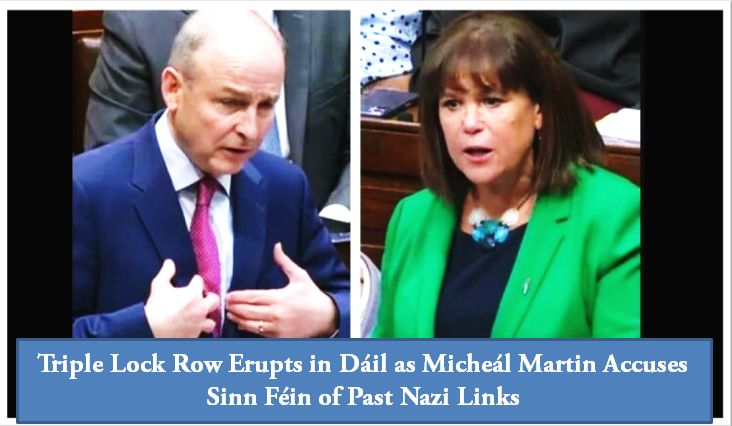
Dublin: A heated political confrontation erupted in the Dáil over the government’s plans to reform Ireland’s “triple lock” system governing the deployment of Irish troops overseas. Taoiseach Micheál Martin and Sinn Féin leader Mary Lou McDonald clashed during Leaders’ Questions on Tuesday, with Martin’s remarks linking Sinn Féin’s historical positions to Nazi Germany triggering uproar in the chamber.
The confrontation came ahead of a three-hour debate scheduled for Wednesday afternoon on legislation to remove the United Nations mandate requirement from the existing system. Opposition TDs also displayed placards calling for the protection of Ireland’s neutrality.
What is the triple lock?
The triple lock is the system governing the deployment of Irish Defence Forces personnel overseas as part of international peacekeeping and peace-support operations.
Under the current arrangements, three conditions must generally be met before more than 12 Irish troops can be deployed as part of an international force:
-
Government approval: The Irish government must approve the deployment.
-
Dáil approval: The deployment must receive approval from the Dáil.
-
United Nations authorisation: The mission must have the required UN mandate.
The system is intended to ensure that overseas deployments receive executive, parliamentary and international approval. The proposed changes would remove the UN mandate requirement while retaining government and Dáil approval.
Government seeks to remove the UN requirement
The government argues that the current system can prevent Ireland from participating in international peace-support missions when the UN Security Council is unable to reach agreement or a permanent member exercises its veto.
Ministers say reform would give Ireland greater flexibility in deciding whether to participate in overseas missions, without removing domestic political oversight.
The proposed changes are contained in the Defence (Amendment) Bill, introduced by Defence Minister Helen McEntee and approved by Cabinet in June.
However, the proposal has faced strong opposition from parties and TDs who argue that removing the UN requirement would weaken an important safeguard underpinning Ireland’s military neutrality.
McDonald demands referendum
During Leaders’ Questions, McDonald accused the government of pushing ahead with the legislation without seeking the consent of the Irish people.
She warned that removing the triple lock would move Ireland away from peacekeeping and towards what she described as “military adventurism”. She also argued that the changes could bring Ireland closer to the European Union’s military structures.
McDonald said the triple lock was central to protecting Irish neutrality and called for a referendum on the proposed changes.
She also criticised the Government for seeking to limit the time available for parliamentary scrutiny, arguing that legislation with such significant implications for Irish foreign policy deserved a more extensive debate.
Martin launches historical attack on Sinn Féin
Martin defended the government’s position, describing peacekeeping as one of Ireland’s most important contributions to international affairs. He rejected McDonald’s suggestion that the proposed changes would mean Ireland was abandoning its peacekeeping commitments, calling the claim exaggerated.
The Taoiseach then launched a sharp attack on Sinn Féin’s historical record, saying he would take no lectures from a party he accused of having supported Nazism during the Second World War.
Martin alleged that Sinn Féin leaders had collaborated with the Hitler regime while Éamon de Valera maintained Ireland’s policy of neutrality. He singled out former IRA chief of staff Seán Russell, whose links with Nazi Germany remain a controversial part of Irish history.
The remarks prompted shouting and protests from opposition members, forcing the Ceann Comhairle to intervene and call for order.
Opposition TDs continued to display placards bearing messages in support of Irish neutrality as tensions rose in the chamber.
Seán Russell’s controversial legacy
Russell was an Irish republican who became chief of staff of the IRA during the early years of the Irish Free State. He travelled to Nazi Germany seeking support for the IRA’s campaign to overthrow the Free State and achieve Irish unity.
He died aboard a German U-boat in 1940 while returning to Ireland.
A statue of Russell was unveiled in 1951 and subsequently became the focus of repeated controversy and attacks. The monument remains a contentious symbol in debates about Irish republican history.
Martin referred to Russell’s links with Nazi Germany and questioned Sinn Féin’s credibility in challenging the government over neutrality. He also pointed to McDonald’s previous attendance at a commemoration associated with Russell’s memorial.
Irish Samachar English News