
Spain Mourns 68 Victims of High-Speed Train Collision
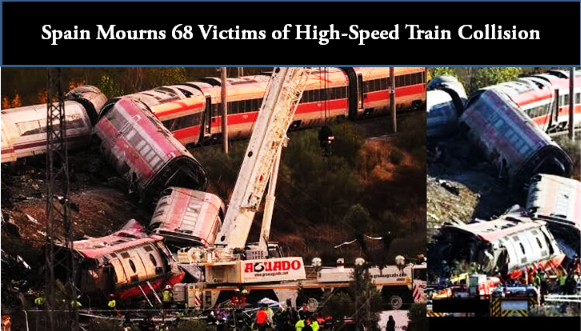
Madrid: Spain is in mourning following a devastating high-speed train collision near Urda, in the province of Toledo, that claimed at least 68 lives. Three days of official mourning began on Thursday as rescue teams continued searching through the wreckage. Meanwhile, relatives of missing passengers waited anxiously for information about their loved ones.
The accident occurred on Wednesday morning on the Madrid–Seville high-speed railway line, when a state-owned Renfe train collided with the rear of a stationary train operated by private company Iryo. A total of 544 passengers were aboard the two trains. The force of the impact caused several carriages to derail, with some plunging down a nearby embankment.
According to information released on Wednesday night, 53 people remained in hospitals across Castilla-La Mancha, while 56 had been discharged. An earlier announcement from the Health Ministry said 15 people were in critical condition.
A technical failure followed by a critical error
Investigators are examining a technical failure that occurred shortly before the collision and the subsequent decision to authorise the Renfe train to resume its journey.
Transport Minister Óscar Puente said a computer-related failure had disrupted the safety system along a 63-kilometre section of the railway line, forcing trains to stop.
However, the control centre subsequently authorised the Renfe train to continue at normal speed, despite a red signal indicating that it should remain stopped. Another train was still stationary on the track ahead.
Puente described the decision as inexplicable and said the circumstances surrounding the authorisation were being investigated. Authorities are also examining evidence to establish the train’s actual speed at the time of the collision.
The final findings are expected to clarify how the accident occurred and determine whether any individuals or procedures were responsible.
Rescue workers continued operations through the night, using cranes and other heavy equipment to remove damaged carriages from the wreckage.
A support centre for relatives was established at a school in Urda, where Red Cross personnel and psychologists are assisting families seeking information about missing passengers.
The Civil Guard has also established facilities in Madrid, Toledo, Córdoba and Seville to collect DNA samples from relatives to help identify those who died. Blood donation centres have been opened across Castilla-La Mancha and Madrid to support the injured.
Another tragedy within a year
Prime Minister Pedro Sánchez pledged a thorough investigation into the disaster, promising that any safety violations uncovered would be addressed. He said the immediate priority was to assist survivors and provide support to the victims’ families.
The latest collision has renewed concerns about railway safety in Spain, coming just months after another deadly rail accident in January that killed 46 people. The two tragedies have intensified scrutiny of the country’s high-speed rail network and raised questions about the effectiveness of its safety systems and operational procedures.
Irish Samachar English News